All Nodes Distance K in Binary Tree

AfterAcademy Tech
•
02 Jun 2020
Difficulty: Medium
Companies: Microsoft
Understanding The Problem
Problem Description
We are given a binary tree with root node root, a target node target, and an integer value k. Write a program to return a list of the values of all nodes that have a distance k from the target.
Problem Note →
- The answer can be returned in any order.
- The given tree is non-empty.
- Each node in the tree has unique values.
- The target node is a node in the tree.
Given the following binary tree: root = [5, 6, 3, 1, 7, 9, 4, null, null, 2, 0]
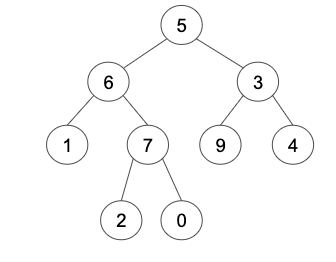
Example 1
Input: root = [5, 6, 3, 1, 7, 9, 4, null, null, 2, 0], target = 6, K = 2
Output: [2,0,3]
Explanation: The nodes that are a distance 2 from the target node with value 6 have values 2, 0, and 3.
The node structure passed to your function will be
class TreeNode
{
    int val
    TreeNode left
    TreeNode right
}
Solutions
- Convert Tree into Graph: Create a hashmap of nodes and their parents. Perform BFS from the target node and add all nodes at distance K to result.
- Percolate Distance: Perform DFS from the root and check for the distance of target node distance from each node.
You may try this problem here.
1. Convert Tree into Graph
The question says, that we have to find out all the nodes that are at a distance of K from the target node. If you are able to imagine that the given directed binary tree to be an undirected graph, then we could perform a BFS search from the target nodes up to the distance K, then it would be our answer.
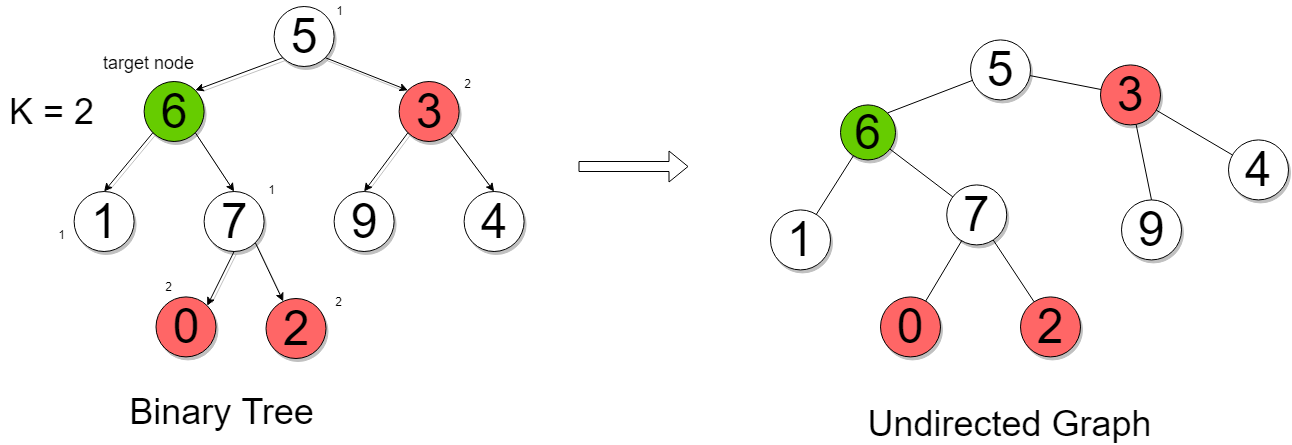
Solution steps
- Create a graph from the given tree.
- The graph can be adjacency list or adjacency matrix
- You can build the graph by making a postorder traversal of the tree.
2. Then from the target node, make a BFS search up to a distance k from the target node and store the kth nodes in the result array.
3. Now simply return the result array.
Pseudo Code
class Solution {
public:
    // Graph is an adjacency list
    map(int, []) Graph
    int[] ans

    void buildGraph(TreeNode node, TreeNode parent) {
        if (not node)
            return
        if (not Graph.count(node.val)) {
            if (parent) {
                Graph[node.val].add(parent.val)
                Graph[parent.val].add(node.val)
            }
            buildGraph(node.left, node)
            buildGraph(node.right, node)
        }
    }

    void bfs(TreeNode target, int k) {
        queue q
        // visited map of int : bool
        map <int, bool> visited
        int depth = 0
        if (k == 0) {
            ans.add(target.val)
            return
        }
        q.push(target.val)
        while (not q.empty()) {
            depth = depth + 1
            int q_size = q.size()
            for (int i=0 to i<q_size) {
                int curr_node = q.front()
                visited[curr_node] = true
                q.pop()
                for (int neighbour in Graph[curr_node]) {
                    if (not visited.count(neighbour)) {
                        if (depth == k)
                            ans.add(neighbour)
                        else
                            q.push(neighbour)
                    }
                }
            }
            if (depth == k)
                return
        }
    }

    int[] distanceK(TreeNode root, TreeNode target, int K) {
        buildGraph(root, nullptr)
        bfs(target, K)
        return ans
    }
}
Complexity Analysis
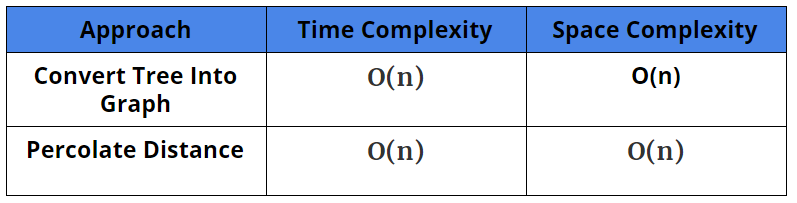
Time Complexity: O(n)
Space Complexity: O(n)
Critical Ideas to Think
- How did we convert the binary tree into an undirected graph?
- Did we use the adjacency list to create the graph?
- Why did we perform the BFS up to the distance k from the target node?
- Can we solve this problem using the adjacency matrix?
2. Percolate Distance
The problem can also be solved with the help of recursion. If we will just try to traverse the tree and check if the current node during traversal is the target node. If its a target node, then simply get the nodes by performing a preorder traversal like subtree_add function in pseudo-code up to a distance k while considering the target node as the root. If the node is not the target node, then we could check if the target node is in the left subtree or in the right subtree.
As soon as we determine that the target node is in the left subtree, then we will go to the right subtree and add the nodes at a distance K from the target node and if the target node is in the right, then we will traverse to the left. Consider the following example →
From root, say the target node is at depth 3 in the left branch. It means that any nodes that are distance K - 3 in the right branch should be added to the answer.
Solution Steps
- Traverse every
nodewith a depth-first search. We'll add all nodesxto the answer such thatnodeis the node on the path fromxtotargetthat is closest to theroot. dfs(node)will return the distance fromnodeto thetarget. Then, there are 4 cases:
- If
node == target, then we should add nodes that are distanceKin the subtree rooted attarget. - If
targetis in the left branch ofnode, say at a distanceL+1, then we should look for nodes that are distanceK - L - 1in the right branch. - If
targetis in the right branch ofnode, the algorithm proceeds similarly. - If
targetisn't in either branch ofnode, then we stop.
Pseudo Code
class Solution {
    int[] ans
    TreeNode target
    int k
    int[] distanceK(TreeNode root, TreeNode Target, int K) {
        target = Target
        k = K
        dfs(root)
        return ans
    }
   // Return vertex distance from node to target if exists, else -1
    int dfs(TreeNode node) {
        if (node is null)
            return -1
        else if (node is target) {
            subtree_add(node, 0)
            return 1
        } else {
            int L = dfs(node.left)
            R = dfs(node.right)
            if (L != -1) {
                if (L == K)
                   ans.add(node.val);
                subtree_add(node.right, L + 1)
                return L + 1
            } else {
                if (R != -1) {
                    if (R == K) ans.add(node.val)
                    subtree_add(node.left, R + 1)
                    return R + 1
                } else {
                    return -1
                }
            }
        }
    }
   // Add all nodes 'K - dist' from the node to answer.
    void subtree_add(TreeNode node, int dist) {
        if (node is null)
            return
        if (dist is K)
            ans.add(node.val)
        else {
            subtree_add(node.left, dist + 1)
            subtree_add(node.right, dist + 1)
        }
    }
}
Complexity Analysis
Time Complexity: O(n)(How?)
Space Complexity: O(n), due to recursive stack space
Critical Ideas to Think
- How did we check if the target node is in the left or the right subtree from the current node during DFS traversal?
- How did we able to find out, what distance is the target node from the current node in constant time during the DFS traversal?
- What does
subtree_addfunction represent here?
Comparison of Different solutions
Suggested problems to solve
- Print all nodes at distance K from the given node: Iterative Approach
- Distance between two nodes of a binary tree with node values from 1 to N
- Print nodes at k distance from the root
- Print all the neighboring nodes within distance K
- Print nodes at k distance from root | Iterative
If you have any more approaches or you find an error/bug in the above solutions, please comment down below.
Happy Coding! Enjoy Algorithms!
Written by AfterAcademy Tech
Share this article and spread the knowledge
Read Similar Articles
AfterAcademy Tech
Find The Height Of a Binary Tree
Given a binary tree, write a program to find the maximum depth of the binary tree. The maximum depth is the number of nodes along the longest path from the root node to the leaf node. A leaf is a node with no child nodes.
AfterAcademy Tech
Invert a Binary Tree - Interview Problem
Given a binary tree, invert the binary tree and return it. An inverted form of a Binary Tree is another Binary Tree with left and right children of all non-leaf nodes interchanged. You may also call it the mirror of the input tree.

AfterAcademy Tech
Find Diameter of Binary Tree
Given a binary tree, you need to compute the length of the diameter of the tree. The diameter of a binary tree is the length of the longest path between any two nodes in a tree. This path may or may not pass through the root.

AfterAcademy Tech
Maximum path sum in a binary tree
Given a non-empty binary tree, find maximum path sum. For this problem, a path is defined as any sequence of nodes from some starting node to any node in the tree along with the parent-child connections.