What is the two pointer technique?

AfterAcademy Tech
•
18 Dec 2019

Concept Introduction
Two pointer approach is an essential part of a programmer’s toolkit, especially in technical interviews. The name does justice in this case, it involves using two pointers to save time and space. (Here, pointers are basically array indexes).
Just like Binary Search is an optimization on the number of trials needed to achieve the result, this approach is used for the same benefit.
The idea here is to iterate two different parts of the array simultaneously to get the answer faster.
Implementation
There are primarily two ways of implementing the two-pointer technique:
1. One pointer at each end
One pointer starts from beginning and other from the end and they proceed towards each other
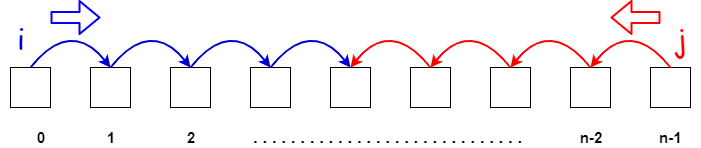
Example : In a sorted array, find if a pair exists with a given sum S
- Brute Force Approach: We could implement a nested loop finding all possible pairs of elements and adding them.
bool pairExists(int arr[], int n, int S)
{
    for(i = 0 to n-2)
        for(j = i+1 to n-1)
            if(arr[i] + arr[j] == S)
                return true
    return false
}
Time complexity: O(n²)
- Efficient Approach
bool pairExists(int arr[], int n, int S)
{
    i = 0
    j = n-1
    while( i < j)
    {
        curr_sum = arr[i] + arr[j]
        if ( curr_sum == S)
            return true
        else if ( curr_sum < X )
            i = i + 1
        else if ( curr_sum > X )
            j = j - 1
    }
    return false
}
Time Complexity: O(n)
2. Different Paces
Both pointers start from the beginning but one pointer moves at a faster pace than the other one.
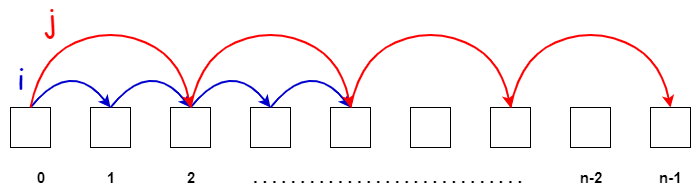
Example: Find the middle of a linked list
- Brute Force Approach: We can find the length of the entire linked list in one complete iteration and then iterate till half-length again.
ListNode getMiddle(ListNode head)
{
    len = 0
    ListNode curr = head
    while ( curr != NULL )
    {
        curr = curr.next
        len = len + 1
    }

    curr = head
    i = 0
    while(i != len / 2)
    {
        curr = curr.next
        i = i + 1
    }
    return curr
}
- Efficient Approach: Using a two-pointer technique allows us to get the result in one complete iteration
ListNode getMiddle(ListNode head)
{
    ListNode slow = head
    ListNode fast = head
   while(fast && fast.next)
    {
        slow = slow.next
        fast = fast.next.next
    }
   return slow
}
How does this technique save space?
There are several situations when a naive implementation of a problem requires additional space thereby increasing the space complexity of the solution. Two-pointer technique often helps to decrease the required space or remove the need for it altogether
Example: Reverse an array
- Naive Solution: Using a temporary array and fillings elements in it from the end
int[] reverseArray(int arr[], int n)
{
    int reverse[n]
   for ( i = 0 to n-1 )
        reverse[n-i-1] = arr[i]

    return reverse
}
Space Complexity: O(n)
- Efficient Solution: Moving pointers towards each other from both ends and swapping elements at their positions
int[] reverseArray(int arr[], int n)
{
    i = 0
    j = n-1
   while ( i < j )
    {
        swap(arr[i], arr[j])
        i = i + 1
        j = j - 1
    }
   return arr
}
Space Complexity: O(1)
Some popular examples of two pointer approach
Pseudo code: Merge two sorted array
void mergeSortedArrays(int A[], int B[], int n1,
                             int n2, int C[])
{
    int i = 0, j = 0, k = 0
    while (i<n1 && j <n2)
    {
        if (A[i] < B[j])
        {
            C[k] = A[i]
            k = k + 1
            i = i + 1
        }
        else
        {
            C[k] = B[j]
            k = k + 1
            j = j + 1
        }
    }
    while (i < n1)
    {
        C[k] = A[i]
        k = k + 1
        i = i + 1
    }
    while (j < n2)
    {
        C[k] = B[j]
        k = k + 1
        j = j + 1
    }
}
Both pointers are moving forward in the same direction and each step of iteration we are moving one pointer forward. Time Complexity = O(n1 + n2) (Think!)
Pseudo code: Partition function in quick sort
int partition (int A[], int l, int r)
{
    int pivot = A[r]
    int i = l - 1
    for (j = l to r-1)
    {
        if (A[j] < pivot)
        {
            i++
            swap(A[i], A[j])
        }
    }
    swap(A[i + 1], A[r])
    return (i + 1)
}
Both pointers are moving forward in the same direction with different pace i.e. j is incrementing by 1 after each iteration but i is incrementing if (A[j] < pivot). Time complexity = O(n) (Think!)
Suggested Problems to solve
- Move all zeroes to the end
- Merge two sorted lists
- Find the closest pair from two sorted arrays
- Find a triplet with the given sum
- Intersection of two sorted array
- Remove duplicates from sorted array
- Minimum Absolute Difference in an Array
- maximum j – i such that A[j] > A[i]
- Container with Most Water
Happy Coding!
AfterAcademy Data Structure And Algorithms Online Course — Admissions Open
Written by AfterAcademy Tech
Share this article and spread the knowledge
Read Similar Articles
AfterAcademy Tech
Add Two Numbers as Lists - Interview Problem
You are given two non-empty linked lists representing two non-negative integers. The digits are stored in reverse order and each of their nodes contains a single digit. Add the two numbers and return it as a linked list.

AfterAcademy Tech
Find the intersection of two unsorted arrays - Interview Problem
Given two integer arrays A[] and B[] of size m and n, respectively. We need to find the intersection of these two arrays. The intersection of two arrays is a list of distinct numbers which are present in both the arrays. The numbers in the intersection can be in any order.
AfterAcademy Tech
Median of the Two Sorted Array of Same Size
There are two sorted arrays nums1 and nums2 of size n. Find the median of the two sorted arrays.
AfterAcademy Tech
Merge Two Sorted Lists - Interview Problem
Merge two sorted linked lists and return it as a new sorted list. The new list should be made by splicing together the nodes of the first two lists.