Combination Sum

AfterAcademy Tech
•
18 Jul 2020
Difficulty: Medium
Asked in: Amazon, Facebook, Adobe
Understanding The Problem
Problem Description
Given an array of integers arr[] and a target number k, write a program to find all unique combinations in arr[] such that the sum of all integers in the combination is equal to k.
Problem Note:
- All numbers (including target number
k) will be positive integers. - The same number may be chosen from
arr[]the unlimited number of times. - Elements in a combination (
a1,a2, … ,ak) must be in non-descending order. (i.e,a1≤a2≤ … ≤ak). - The combinations themselves must be sorted in ascending order, i.e., the combination with the smallest first element should be printed first.
- The solution set must not contain duplicate combinations.
Example 1
Input: arr[] = [2, 3, 6, 7], k = 7
Output:
[
  [7],
  [2,2,3]
]
Explanation: All the unique combinations whose sum is 7 is printed.
2+2+3 = 7
7 = 7
Example 2
Input: arr[] = [2,3,5], k = 8
Output:
[
    [2,2,2,2],
    [2,3,3],
    [3,5]
]
Explanation: All the unique combinations whose sum is 8 is printed.
2+2+2+2 = 8
2+3+3 = 8
3+5 = 8
Backtracking Solution
First of all, we need to sort the array, to ensure the combination to be unique and also the numbers in the combination to be listed in a non-descending order.
Then, we define a recursive function with the signature as:
backtrack(int[][] res, int[] candidate, int [] nums, int target, int start)
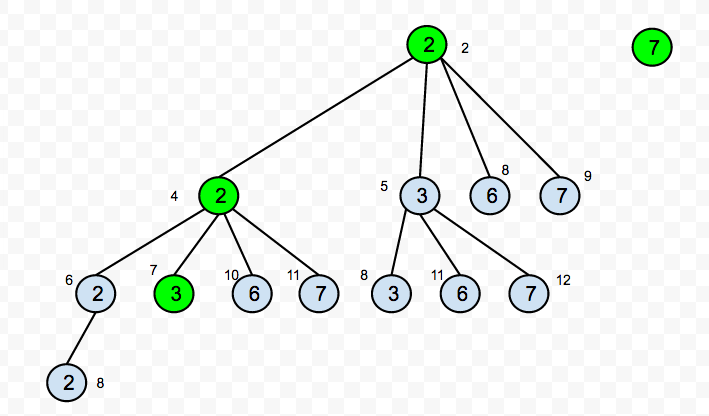
where "candidate" is the list that we could take numbers from, "result" is the list of combination that we have accumulated so far, "start" is the starting point at which we could take numbers from forwards (no backward), and "target"is the rest sum that we need to achieve. A recursion tree for the above example might look like this →
As a recursive function, the bottom cases for the backracking() are:
- 1. The value of the
startis equal to thetarget, we then find a combination, so just add thestartto theresultand output the result. - The value of the
startis greater than thetarget, then it is impossible to find the combination onwards because thecandidatesthe list is sorted and all the following elements would be greater than thetargetas well.
Given the above recursive function, we could solve the problem by calling the function for each candidate starting from the start point.
For each candidate, we first try to add the candidate into the result, and then again starting from this candidate, we call the backtracking() function to obtain the result for the new target afterwards.
Solution Steps
- Create a
resultarray to store the valid sequences - Create a
currarray that will store the current sequence found in the path of the recursion tree. - A backtrack function that will go into the recursion until the target is achieved, otherwise, it should backtrack to the previous phase as
targetbecomes less than 0. - At any point in time, if
targetbecomes0then add thecandidatearray to the result as the values in thecandidatearray must be sum up to the given target. - If those are not the cases then, one by one add the elements in the candidate array and recursively move forward.
Pseudo Code
int[][] combinationSum(int[] nums, int target) {
    int[][] result
    sort(nums)
    int[] curr
    backtrack(result, curr, nums, target, 0)
    return result
}

void backtrack(int[][] res, int[] candidate, int [] nums, int target, int start) {
    if(target < 0)
        return
    else
        if(target == 0)
            res.add(candidate)
        else{
            for(int i = start; i < nums.length; i++) {
                candidate.add(nums[i])
                backtrack(list, candidate, nums, target - nums[i], i)
                // not i + 1 because we can reuse same elements
                candidate.remove(candidate.size() - 1)
            }
    }
}
Complexity Analysis
Time Complexity: O(l^k)
- Where l is the length of the array, k is the length of the longest possible combination (namely
target / minInArray).
i.e. If the min value in the array is 1, and the target is 9, the longest length of possible combination is 9 (9/1).
Space Complexity: O(k), for storing the path, which could be k long at most.
Critical Ideas To Think
- In the
backtrackfunction why did we start the for loop fromstartthanstart + 1? - If the question requires that the same number can be chosen only one time, then what change should we have to make in the pseudo code?
- What are the base cases of the recursion?
- Why we are appending the sequence to our result only when the target is equal to zero?
- Give a thought over the time complexity which is O(l^k).
- Find problems where you can apply a similar approach.
Suggested Problem To Solve
- Letter combination of a phone number
- Find a unique combination of unique numbers that sum up to target
- Search word in a matrix
- Print all permutations of a string
Happy Coding!
Team AfterAcademy!!
Written by AfterAcademy Tech
Share this article and spread the knowledge
Read Similar Articles
AfterAcademy Tech
Combinations
Given two integers n and k, Write a program to return all possible combinations of k numbers out of 1 2 3 ... n. Elements in a combination must be in a non-descending order. The combinations themselves must be sorted in ascending order, i.e., the combination with the smallest first element should be printed first.
AfterAcademy Tech
Path Sum In Binary Tree
Given a binary tree and a sum, write a program to determine if the tree has a root-to-leaf path such that adding up all the values along the path equals the given sum.Its an easy problem based on Binary tree traversal and a famous interview question
AfterAcademy Tech
Maximum Subarray Sum
You are given an array A[] with n elements. You need to find the maximum sum of a subarray among all subarrays of that array. A subarray of array A[] of length n is a contiguous segment from A[i] through A[j] where 0<= i <= j <= n.

AfterAcademy Tech
Triplet With Zero Sum
Given an array arr[ ] of n integers, are there elements x, y, z in arr such that x + y + z = 0? Find all unique triplets in the array which gives the sum of zero. The problem is asked in many interviews and required do be solved in O(n^2) with constant space.