What is Specialization in DBMS?

AfterAcademy Tech
•
19 Jan 2020
We have already studied various features of the E-R model. As the data is growing the complexity of managing these data is also increasing. We can't manage these data with the help of the traditional E-R data model. So to manage the increasing complexity we have designed an extended E-R Model. The extended E-R Model includes various concepts like Specialization, Generalization, Aggregation, etc. In this blog, we will cover one of the topics of the extended E-R Model. i.e Specialization.
Specialization
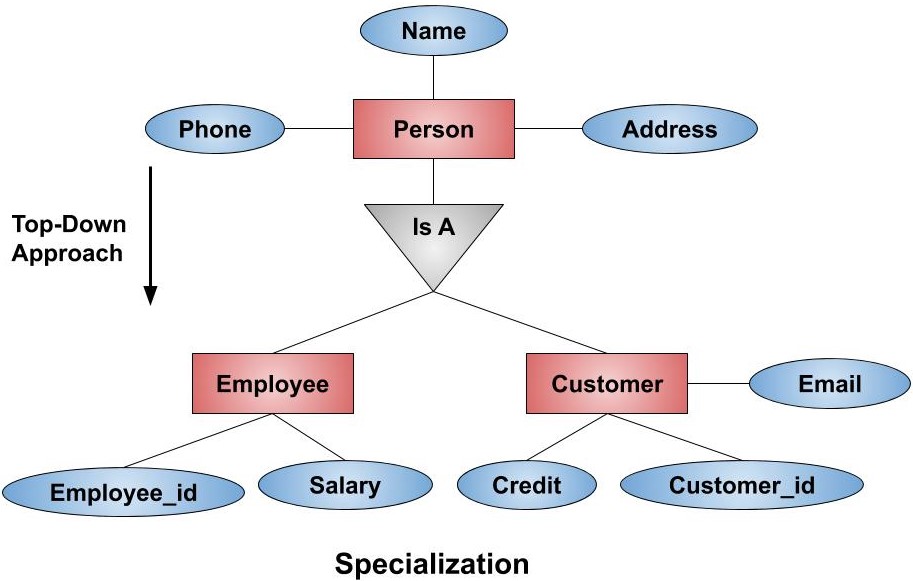
Specialization, as the name suggests, is a process of specializing an entity type into a more specified entity. In this process, we specialize a higher-level entity type by adding some additional attributes to the entity type. In this approach, we add some additional attributes and specialize a higher-level entity type into some other entity type. It is a top-down approach in which a higher-level entity is broken into smaller entities. For example, Animals can be mammals or reptiles. Then these mammals can either be tiger, elephant or humans. The reptiles can be snakes or lizards. So we are specializing as we are moving towards any particular type of animal.
Example: If we have a person entity type who has attributes such as Name, Phone_no, Address. Now, suppose we are making software for a shop then the person can be of two types. This Person entity can further be divided into two entity i.e. Employee and Customer. How we will specialize it? We will specialize the Person entity type to Employee entity type by adding attributes like Emp_no and Salary. Also, we can specialize the Person entity type to Customer entity type by adding attributes like Customer_no, Email, and Credit. These lower-level attributes will inherit all the properties of the higher-level attribute. The Customer entity type will also have attributes like Name, Phone_no, and Address which was present in the higher-level entity.
This is all about Specialization. Hope you learned something new today.
Do share this blog with your friends to spread the knowledge. Visit our YouTube channel for more content. You can read more blogs from here.
Keep Learning 🙂
Team AfterAcademy!
Written by AfterAcademy Tech
Share this article and spread the knowledge
Read Similar Articles
AfterAcademy Tech
What is Cross-Join in DBMS?
In this blog, we will learn how to cross-join two tables in DBMS, and what are the benefits of doing it with example.
AfterAcademy Tech
What is a Stored Procedure in DBMS?
In this blog, we will learn what is a stored procedure in DBMS, and how it is executed depending on the number of parameters passed.
AfterAcademy Tech
What is the difference between DBMS and RDBMS?
In this blog, we will learn what is RDBMS and how it is different from DBMS. People often use these words intechangeably. But there is a difference between these two terms. So, let's learn how.
AfterAcademy Tech
What is Join in DBMS and what are its types?
In this blog, we will learn how to join two tables in DBMS. We will also learn about the various types of joins, mainly the inner and the outer join.