
What is the difference between DBMS and RDBMS?

AfterAcademy Tech
•
10 Dec 2019
In the previous blogs, we have read about DBMS. Though it had many advantages over the traditional file system, the main issue with the DBMS was data redundancy. No doubt, DBMS helps in reducing data redundancy, but not to that extent. RDBMS(Relational Database Management System) is an extension of DBMS designed to remove the inefficiencies of DBMS. So, if you haven't read about DBMS read it from here. Now, first, we will see what is RDBMS and then how it is different from DBMS. So, let's get started.
RDBMS
Relational Database Management System or simply RDBMS is a type of DBMS which is based on the relational model. It came into existence in the 1970s and was introduced by E.F.Codd. It stores the data in tabular format. The data is organised into tables.
Tables
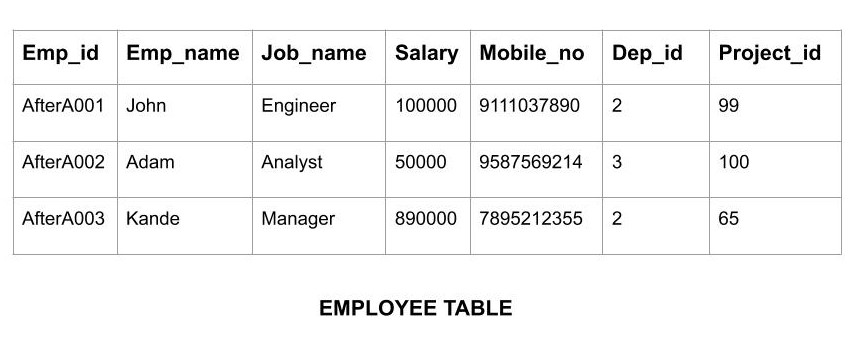
The table is a collection of related data which are present in rows and columns. Tables are the most common way of storing data in the database. Tables can have hundreds, thousands or millions of rows and columns. Example: Following is an example of an employee table which contain three rows and seven columns.
Attributes or Columns
Each column is labelled with a descriptive name and has a specific data type defined as the attribute of a table. In the above example, we have seven fields (Emp_id, Emp_name, Job_name, Salary, Mobile_no, Dep_id, Project_id). The Emp_id is of data type Varchar which tells that it can hold only varchar value. All the values in a column are of the same data type.
Row or Record
Each individual entry which exits in a table is called a record. In the above example, we have three rows or records each for John, Adam and Kande. Each row denotes the information about the a particular employee.
Difference between DBMS and RDBMS
- Storage: DBMS stores the data as a file while RDBMS stores the data in the form of tables(tabular format). The columns contain information about the attributes(characteristics) whereas the rows contain all the attributes information about any particular object. In the above example for the employee table, we can see how the data of the employee is stored in row and column format.
- Data Redundancy: Data redundancy is present in DBMS whereas it is removed in RDBMS. Though the data redundancy is reduced in DBMS as compared to the file system but in RDBMS it is removed using some more constraints. RDBMS uses normalization to remove the data redundancy.
- Modification of Data: In DBMS as data redundancy is there so it is difficult to modify the data at all the locations. If we make changes at one location and forget to make the changes at other places then there will be two different values for the same data. While in RDBMS there is negligible data redundancy so it is easy to make the changes. We just make the changes in one place and our work is done.
- Data Relationship: In DBMS the data is stored such that there is no relationship between data while in RDBMS the data is stored in the form of tables which are related to each other with the help of foreign keys. Example: If we have some data stored in two files we don't know how the data in those files are related. In RDBMS we can say that two tables are related if we have some common attribute which is present in both the tables.
- Number of Users: DBMS supports single users while RDBMS support multiple users. In DBMS only one user can work at a time while in RDBMS many users can work concurrently on the database.
- Data Access: Data is accessed faster in RDBMS than in DBMS. Since RDBMS provide tabular structure for storing data so data retrieval is fast whereas DBMS doesn't provide a uniform method to access the information. We use SQL query to get the data from the database in RDBMS. Here, we simply run the query and get the required results accordingly.
- Support for distributed Database: DBMS doesn't support distributed database while RDBMS support the distributed database. In DBMS the database is present at any particular location while in RDBMS the database may be spread over on the internet i.e some part of the database may be located in one country like India and other parts of the database in some other country like the US.
- ACID properties: DBMS may or may not follow the ACID(Atomicity, Consistency, Integrity and Durability)properties. This develops inconsistencies in the data. On the other hand, RDBMS follows the ACID properties and thus the data in RDBMS is consistent.
- Ideally Suited For: DBMS mainly deals with a small quantity of data while RDBMS is designed to handle a large quantity of data. If we use DBMS for fetching a larger amount of data then its performance is slow.
- Example: Microsoft Access, Dbase, FoxPro are some of the DBMS software while some of the widely used RDBMS are MySQL, Oracle, SQL Server etc.
Conclusion
From the above discussion, we can conclude that RDBMS is more fast, efficient and popular. Though DBMS is good for the smaller organizations, large organisations need RDBMS for its proper functioning. RDBMS removes the limitations of the DBMS and has many advantages over the DBMS. RDBMS is the advanced version of DBMS.
That's it for this blog. Hope you learned something new today.
Do share this blog with your friends to spread the knowledge. Visit our YouTube channel for more content. You can read more blogs from here.
Keep Learning 🙂
Team AfterAcademy!
Written by AfterAcademy Tech
Share this article and spread the knowledge
Read Similar Articles
AfterAcademy Tech
What are the different types of relationships in DBMS?
In this blog, we will study various types of relationships in DBMS which help in defining the association between various entities. Also, we will discuss the types of participation constraints which may exist between the relationship and the entity type.
AfterAcademy Tech
Difference between Trigger and Stored procedure in DBMS
In this blog, we will learn how triggers are different from stored procedures.
AfterAcademy Tech
What is the difference between SQL and MySQL?
In this blog, we will learn the difference between SQL and MySQL. People use these terms intechangeably. But both are having different meanings.
AfterAcademy Tech
What is the difference between HAVING and WHERE clause?
In this blog, we will learn how WHERE and HAVING clause are used and then see what are the main differences between the WHERE clause and HAVING clause.
