What is Data Encapsulation and de-encapsulation in networking?

AfterAcademy Tech
•
04 Mar 2020
Whenever we send the data from one node to another in a computer network. The data is encapsulated at the sender's side, while it is de-encapsulated at the receiver's end. Actually, the encapsulation of data at various layers of the implementing model(OSI or TCP/IP) adds various functionalities and features to the data transmission. The most important feature that it adds is the security and reliability of data transmission between two nodes in a network.
In this blog, we will mainly learn what is encapsulation. We will also learn the encapsulation and de-encapsulation process in the OSI and TCP/IP models in detail. So, now let us learn these things one by one.
Data Encapsulation
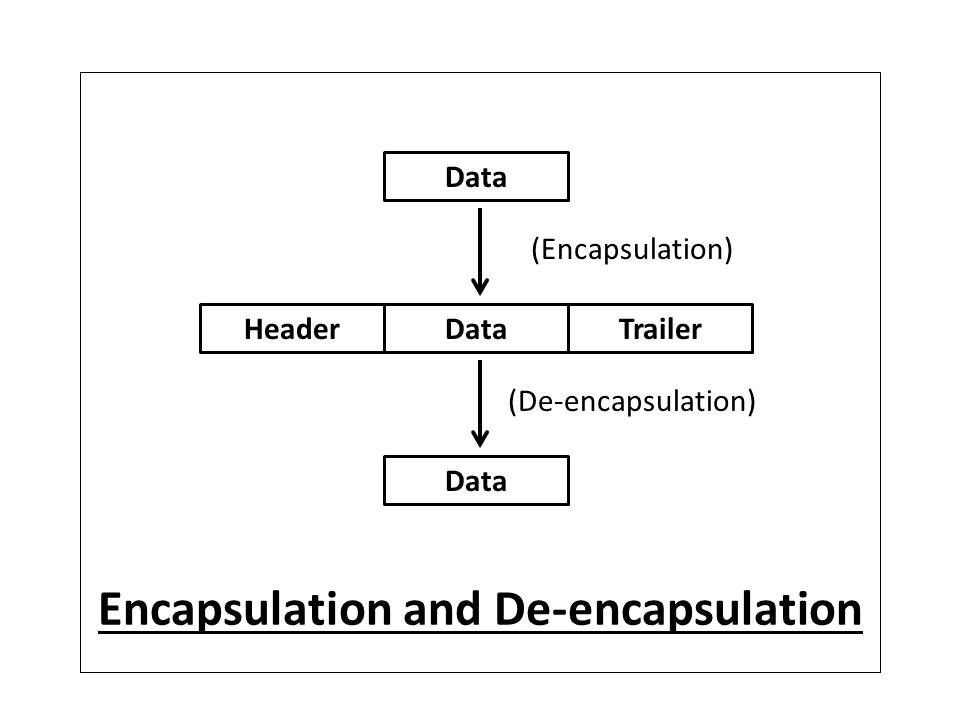
Data Encapsulation is the process in which some extra information is added to the data item to add some features to it. We use either the OSI or the TCP/IP model in our network, and the data transmission takes place through various layers in these models. Data encapsulation adds the protocol information to the data so that data transmission can take place in a proper way. This information can either be added in the header or the footer of the data.
The data is encapsulated on the sender’s side, starting from the application layer to the physical layer. Each layer takes the encapsulated data from the previous layer and adds some more information to encapsulate it and some more functionalities with the data. These functionalities may include proper data sequencing, error detection and control, flow control, congestion control, routing information, etc.
Data De-encapsulation
Data De-encapsulation is the reverse process of data encapsulation. The encapsulated information is removed from the received data to obtain the original data. This process takes place at the receiver’s end. The data is de-encapsulated at the same layer at the receiver’s end to the encapsulated layer at the sender’s end. The added header and trailer information are removed from the data in this process.
The below diagram shows how header and footer are added and removed from the data in the process of encapsulation and de-encapsulation respectively.
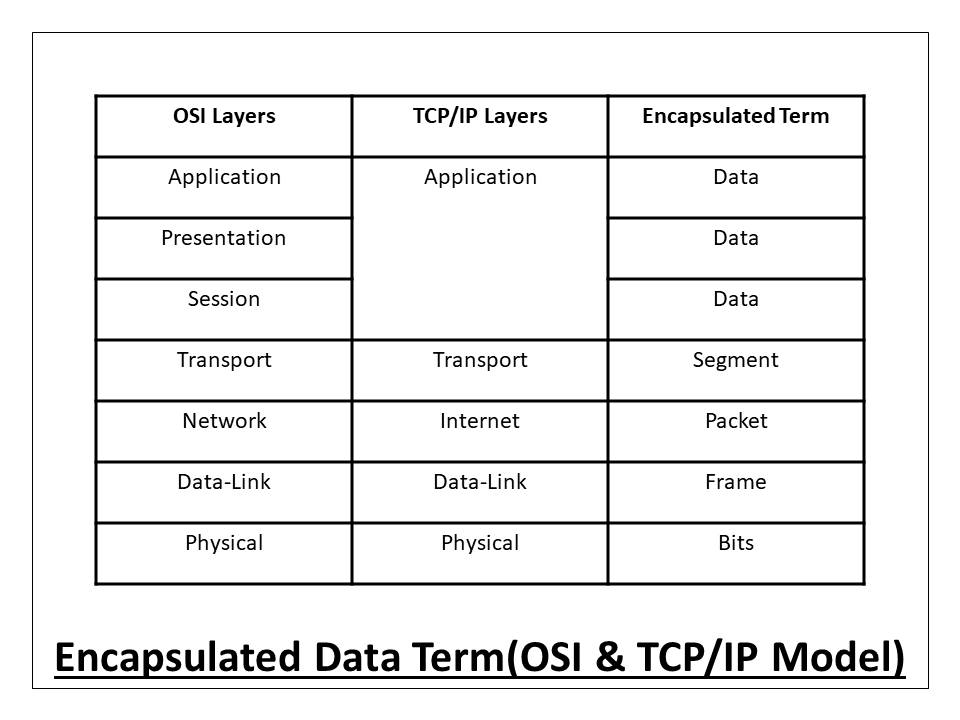
The data is encapsulated in every layer at the sender’s side and also de-encapsulated in the same layer at the receiver’s end of the OSI or TCP/IP model. Actually, we use different terms for the encapsulated form of the data that is described in the below-mentioned diagram.
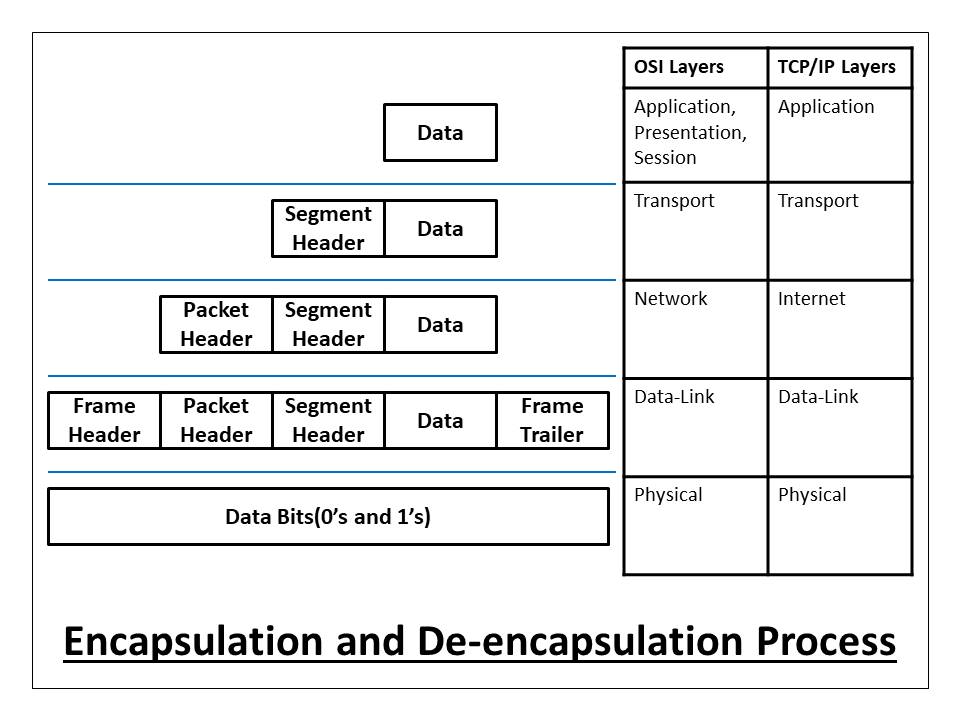
Now, we will learn the whole process of encapsulation and de-encapsulation in the OSI and TCP/IP model step-by-step as mentioned in the below picture.
Encapsulation Process (At sender’s side)
- Step 1: The Application, Presentation, and Session layer in the OSI model, or the Application layer in the TCP/IP model takes the user data in the form of data streams, encapsulates it and forwards the data to the Transport layer. It does not necessarily add any header or footer to the data. But it is application-specific and can add the header if needed.
- Step 2: The Transport layer (in the OSI or TCP/IP model) takes the data stream from the upper layers, and divide it into multiple pieces. The Transport layer encapsulates the data by adding the appropriate header to each piece. These data pieces are now called as data segments. The header contains the sequencing information so that the data segments can be reassembled at the receiver’s end.
- Step 3: The Network layer (in the OSI model) or the Internet layer (in the TCP/IP model) takes the data segments from the Transport layer and encapsulate it by adding an additional header to the data segment. This data header contains all the routing information for the proper delivery of the data. Here, the encapsulated data is termed as a data packet or datagram.
- Step 4: The Data-Link layer (in the OSI or TCP/IP model) takes the data packet or datagram from the Network layer and encapsulate it by adding an additional header and footer to the data packet or datagram. The header contains all the switching information for the proper delivery of the data to the appropriate hardware components, and the trailer contains all the information related to error detection and control. Here, the encapsulated data is termed as a data frame.
- Step 5: The Physical layer (in the OSI or TCP/IP model) takes the data frames from the Data-Link layer and encapsulate it by converting it to appropriate data signals or bits (corresponding to the physical medium).
De-Encapsulation Process (At receiver’s side)
- Step 1: The Physical layer (in the OSI or TCP/IP model) takes the encapsulated data signals or bits from the sender, and de-encapsulate it in the form of a data frame to be forwarded to the upper layer, i.e., the Data-Link layer.
- Step 2: The Data-Link layer (in the OSI or TCP/IP model) takes the data frames from the Physical layer. It de-encapsulates the data frames and checks the frame header whether the data frame is switched to the correct hardware or not. If the frame is switched to the incorrect destination, it is discarded, else it checks the trailer information. If there is any error in the data, data retransmission is requested, else it is de-encapsulated and the data packet is forwarded to the upper layer.
- Step 3: The Network layer (in the OSI model) or the Internet layer (in the TCP/IP model) takes the data packet or datagram from the Data-Link layer. It de-encapsulates the data packets and checks the packet header whether the packet is routed to the correct destination or not. If the packet is routed to the incorrect destination, the packet is discarded, else it is de-encapsulated and the data segment is forwarded to the upper layer.
- Step 4: The Transport layer (in the OSI or TCP/IP model) takes the data segments from the network layer and de-encapsulate it. It first checks the segment header and then reassembles the data segments to form data streams, and these data streams are then forwarded to the upper layers.
- Step 5: The Application, Presentation, and Session layer in the OSI model, or the Application layer in the TCP/IP model takes encapsulated data from the Transport layer, de-encapsulate it, and the application-specific data is forwarded to the applications.
This is all about the data encapsulation and de-encapsulation in computer networks along with its process. Hope you learned something new today. That's it for this blog.
Do share this blog with your friends to spread the knowledge. Visit our YouTube channel for more content. You can read more blogs from here.
Keep Learning 🙂
Team AfterAcademy!
Written by AfterAcademy Tech
Share this article and spread the knowledge
Read Similar Articles
AfterAcademy Tech
What are the Data Transmission Modes in a network?
In this blog, we will learn about different data transmission modes based on the direction of exchange, synchronization between the transmitter and receiver, and the number of bits sent simultaneously in a computer network.
AfterAcademy Tech
What is a network and what are the nodes present in a network?
In this blog, we will mainly learn about a computer network and its node. We will also cover the classification, goals, and applications of a computer network.
AfterAcademy Tech
What is network topology and types of network topology?
In this blog, we will learn about various network topologies, their advantages and disadvantages in a computer network.

AfterAcademy Tech
What are Peer-to-Peer networks and Server-Based networks?
In this blog, we will learn about the types of network based on design, that are Peer-to-Peer, and Server-Based networks. We will also see the applications, advantages, and disadvantages of using these networks.