What is a network and what are the nodes present in a network?

AfterAcademy Tech
•
16 Dec 2019
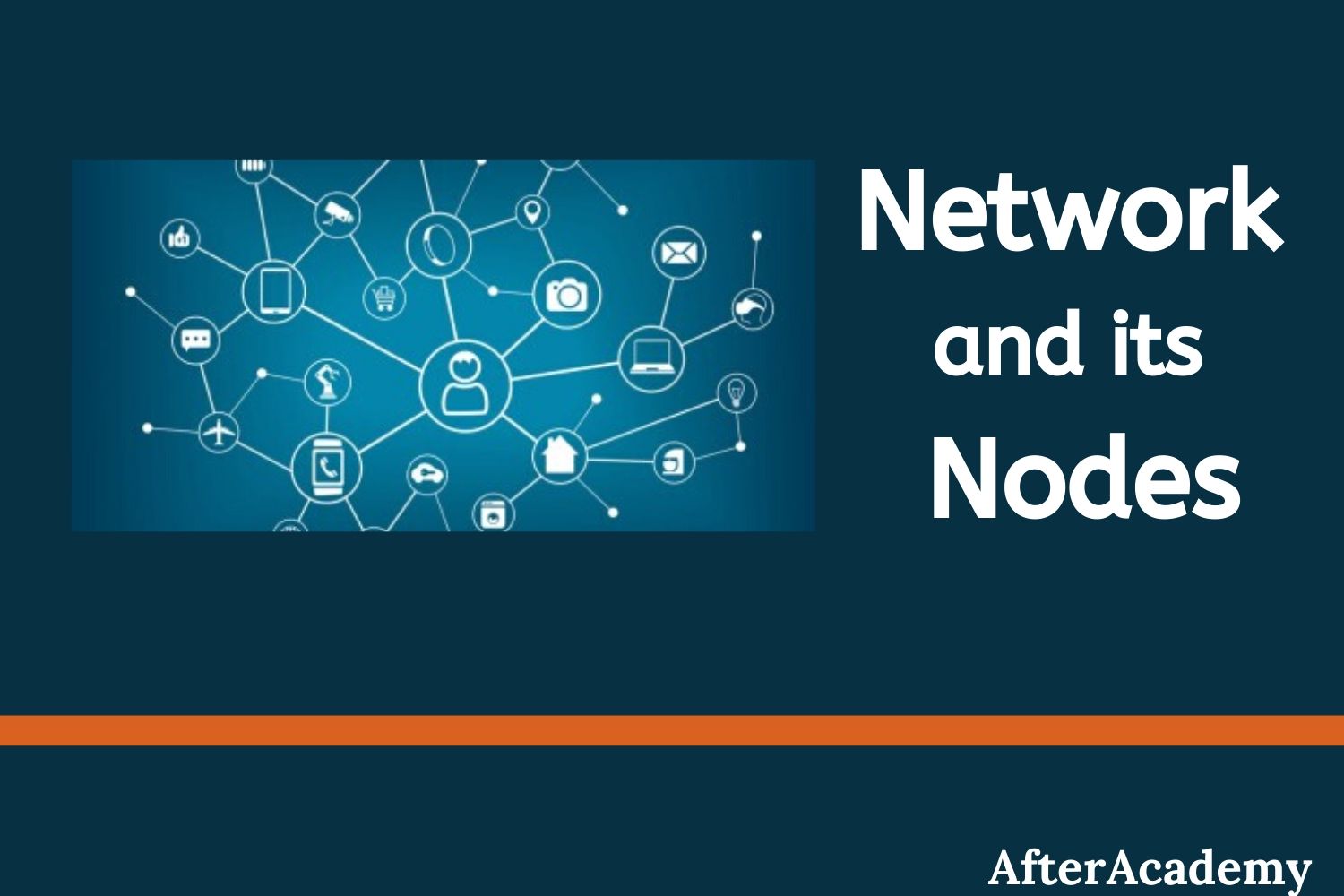
A network is an interconnection between various communication elements connected by various communication links for information interchange. When two or more elements are connected in a limited geographical area to share their resources and information, they are said to be in a network. We can see examples of a network in almost every field around us.
But in this blog, we'll mainly focus on computer networks. We'll also study the nodes present in a network, classifications, goals, and applications of a network.
Computer Network
A computer network is a system in which multiple computers are connected to each other to share information and resources. In other words, it is a network of various communicating devices or elements connected by communication links. The communication elements can be a computer, mobile, router, switch, etc., and communication links can be an optical fibre cable, coaxial fibre cable, wireless LAN, etc.
In a computer network, one process in one device is able to send/receive data to/from at least one process residing in a remote device. The internet is a network of networks. It is not managed by a single organization.
Node
In a computer network, a node is either a connection point, a redistribution point, or a communication point. In other words, a node refers to a point or joint where a connection takes place.
It can be a computer or device that is part of a network. Generally, two or more nodes are needed in order to form a network connection. The definition of a node depends on the network and protocol layer referred to.
A node may be a data communication equipment (that can be used to establish communication, such as modem, hub, bridge, switch, etc.) or a data terminal equipment (that can be an end device, such as digital telephone, handset, printer, host computer, etc.).
A physical network node is an active electronic device that is attached to a network. It is capable of sending, receiving, or forwarding information over a communication channel.
Each device on a network that has a unique logical or IP (Internet Protocol) address can also be termed as a node. When connected in a network, every node in a network must have a MAC address. MAC address is a unique identifier assigned by device manufacturers to a network interface controller (NIC) for communications in a network. NIC is a computer hardware component that connects a computer to a computer network. When connected to the internet or intranet, the nodes are referred to as internet nodes. These nodes are identified by their IP addresses.
Some Data Link layer devices(switches, bridges, WLAN access points, etc.) do not have an IP address. Thus, they are physical but not internet nodes.
In a distributed network, nodes can be clients, servers, or peers. It may also use some virtual nodes, so as to maintain transparency. In cloud computing, each user computer that is connected to a cloud can be treated as an end node.
The degree of connectivity of a node is the measure of the number of connections a node has with other nodes.
Classification of Computer Network
A computer network can be classified on the basis of communication media, functional relationships, topology, and scale of the network.
Now have a look at all these classifications one by one.
- Classification based on communication media:
Computer Networks can be broadly classified in the following two categories based on communication media:
- Wired Network: It can be implemented using coaxial cable, optical fibre cable, etc.
- Wireless Network: It can be implemented using Terrestrial Microwave, Communication Satellites, Wireless LANs.
- Classification according to scale:
Computer Networks can be broadly classified in the following three categories according to scale or the area of a network:
- LAN: It is the acronym for Local Area Network. It is confined to a small geographical area such as a library, college building, etc.
- MAN: It is the acronym for Metropolitan Area Network. It is confined to a large geographical area such as a city or town.
- WAN: It is the acronym for Wide Area Network. It is confined to a very large geographical area such as a country or even the whole world.
- Classification based on Network topology:
Computer Networks can be broadly classified in the following five categories based on network topology i.e based on how the nodes are connected in a network:
- Bus: In this network topology, every node is connected to a single cable, also called a bus.
- Star: In this network topology, all the devices are connected to a single hub through a cable. This hub is the central node. The hub can be active or passive in nature.
- Ring: In this network topology, a ring is formed between various nodes that connect a device with its exactly two neighbour devices.
- Mesh: In this network topology, every node is connected to another node via a particular channel.
- Hybrid: This network topology is a combination of two or more topologies.
- Classification based on Functional Relationship:
Computer Networks can be broadly classified in the following three categories based on functional relationship:
- Active Networking: It allows the packets flowing through a telecommunications network to dynamically modify the operations of a network.
- Client-Server Networking: It is a network in which a client runs the program and access data that are stored on the server.
- Peer-to-Peer Networking: This network facilitates the flow of information from one peer to another without any central server.
Goals of a Computer Network
The main goal of a computer network is mainly related to interconnection and information interchange. Some major goals of a computer network are as follows :
- Resource Sharing: All the devices present in a computer network can share their resources with each other.
- Reliability: A computer network makes the system reliable. If one node fails, the working of all nodes will not be affected.
- Money Efficiency: In a computer network, nodes can share hardware and software components with each other, thus making it money efficient.
- Scalability: A computer network makes the system scalable. We can add or remove the nodes from the network with our convenience.
Applications of Computer Network
A computer network can be applied to various fields some of the application areas are as follows:
- Business Applications: In business a computer network can be used for B2B, and B2C communication.
- Home Applications: Home applications of a computer network can be accessed for remote information, person-to-person communication, electronic commerce, etc.
- Mobile Applications: Mobile applications of computer networks can be mobile banking, communication, etc.
- Social Applications: Social applications of computer networks can be various social networking applications like facebook, twitter, etc.
This is all about computer networks and its node. Hope you learned something new today.
That's it for this blog.
Do share this blog with your friends to spread the knowledge. Visit our YouTube channel for more content. You can read more blogs from here.
Keep Learning 🙂
Team AfterAcademy!
Written by AfterAcademy Tech
Share this article and spread the knowledge
Read Similar Articles
AfterAcademy Tech
Introduction to Node.js - How Node.js works?
In this article we will explore the core structures of the Node.js architecture. Node.js is a popular framework for building backend systems (network applications) which can scale very well. Node.js is a Javascript runtime based on Chrome V8 engine.

AfterAcademy Tech
What is network topology and types of network topology?
In this blog, we will learn about various network topologies, their advantages and disadvantages in a computer network.

AfterAcademy Tech
What are Peer-to-Peer networks and Server-Based networks?
In this blog, we will learn about the types of network based on design, that are Peer-to-Peer, and Server-Based networks. We will also see the applications, advantages, and disadvantages of using these networks.

AfterAcademy Tech
What is a Network Operating System?
In this blog, we'll learn about the Network Operating System and its various features. We'll also see the types of Network Operating System, their advantages, and disadvantages.