
Sort an array in wavy order - Interview Problem

AfterAcademy Tech
•
08 Dec 2019
Difficulty: Easy
Asked in: Amazon, Google, Adobe
Understanding the Problem
Problem Description: Given an array A[] having n elements, you need to sort the array in wavy manner. In wavy manner the array is in the form where A[0] >= A[1] <= A[2] >= A[3] <= A[4] >= …..
For example:
Input: A[]=[15, 6, 7, 5, 3, 30, 70, 45]
Output: A[]=[15, 6, 7, 3, 30, 5, 70, 45] Or A[]=[30, 6, 15, 3, 45, 7, 70, 5] Or any other array in wavy form
Input: A[]=[40, 10, 4, 2, 6, 1]
Output: A[]=[40, 4, 10, 2, 6, 1] Or A[]=[10, 4, 6, 1, 40, 2] Or any other array in wavy form
Possible follow up questions to ask the interviewer:-
- Can we modify the given array? (Ans: Yes, you can.)
- What if there are multiple possible wavy form arrangements in an array?(Ans: Just output any of them.)
Solution
We are going to discuss two possible solutions for this problem →
- Brute Force: Sorting the entire array and then swapping the adjacent elements will make the array in wavy form.
- Optimized Solution using Single Iteration: Simply comparing the elements with its adjacent two elements will do the work.
1. Brute Force
A very simple way of printing an array in wavy way is to sort the entire array and swap all adjacent elements. Using this technique all the elements will get arranged such that A[0]≥A[1]≤A[2]≥A[3]….
Now you can output the array to get it in a wavy way.
Pseudo-code
void SortWavyArray(int A[], int n)
{
	sort(A, A+n)
	for(i = 0 to n-1 with increment of 2)
	       swap(A[i], A[i+1])
}
Complexity Analysis
Suppose we are using comparison based sorting algorithm Heap Sort or Megre Sort for the implementation.
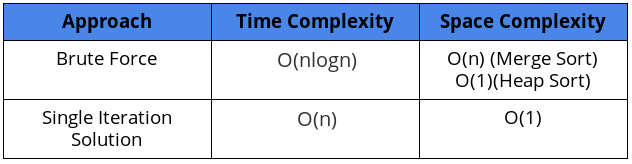
Time complexity: Sorting the array + Single Traversal of array (Increment by 2) = O(nlogn) + O(n) = O(nlogn)
Space Complexity: O(1), if we use Heap Sort, else O(n) if we use Meerge Sort
Critical ideas to think!
- Compare the time and space complexity based on different sorting algorithms like Merge Sort, Heap Sort, Quick Sort and analyse.
- Can you think about the sorting algorithm used in STL or Collection Framework?
- Can you examine the number of swap operations done?
- Can you think of any approach by comparing the adjacent elements?
- What if the input array is sorted in descending order?
2. Single Iteration Solution
We don’t need to use sort, we can simply compare adjacent elements, the element at even places should be greater than the adjacent odd element. Also, we need to check the present even positioned element with the previous odd element. Thus swap will be done when →
- The current even positioned element < previous odd positioned element.
- The current even positioned element < next odd positioned element.
Pseudo-code
void SortWavyArray(int A[], int n)
{
	for(i = 0 to n-1 with increment of 2)
	{
	     if( i > 0  && A[i] > A[i-1] )
		swap(A[i], A[i-1])
	     if( i < (n-1) && A[i] < A[i+1] )
		swap(A[i], A[i+1])
	}
}
Complexity Analysis
Time Complexity: O(n) (Think!)
Space Complexity: O(1)
Critical ideas to think!
- How many comparisons are made in the entire iteration?
- What if you were told to output the lexicographically smallest solution?
- Analyze the algorithm by doing a dry run using your own example.
Comparison of the two solutions
Suggested Problems to Solve
- Print an array in spiral order
- Check if the given array is in wavy order or not
- Check if the given array is beautiful
- Check if the given array is perfect or not
- Rotate a given array in the right direction with d steps
If you have any more approaches or you find an error/bug in the above solutions, please comment down below.
Keep Spreading Codes!!
AfterAcademy Data Structure And Algorithms Online Course - Admissions Open
Written by AfterAcademy Tech
Share this article and spread the knowledge
Read Similar Articles
AfterAcademy Tech
Remove Duplicates in a Sorted Array-Interview Problem
This is an interview problem asked in companies like Google, Microsoft, Amazon. The problem is to remove duplicates from a sorted array or list.
AfterAcademy Tech
Inversion Count in an Array-Interview Problem
Given an array of integers A[ ], if i < j and A[i] > A[j] then the pair (i, j) is called the inversion of an array A[ ]. You need to write a program to find the total counts of inversion in an array A[ ]. The inversion count of an array suggests how close the array is from being sorted. This problem has been asked in Amazon and Google's interview.
AfterAcademy Tech
Find whether an array is a subset of another array - Interview Problem
Given two integer array A[] and B[] of size m and n(n <= m) respectively. We have to check whether B[] is a subset of A[] or not. An array B is a subset of another array A if each element of B is present in A. (There are no repeated elements in both the arrays)

AfterAcademy Tech
Sort a linked list using Insertion Sort - Interview Problem
Sort a linked list using insertion sort and return its head.
