Remove Nth Node From End of List

AfterAcademy Tech
•
06 Apr 2020
Difficulty: Medium
Asked in: Google, Amazon
Understanding the problem
Problem Description: You are given a linked list, write a program to remove the nth node from the end of the list and return the head.
Problem Note:
- It is guaranteed that n ≤ length of linked list
- Try to do this in one iteration.
Example 1
Input: 2->6->1->9, n=2
Output: 2->6->9
Example 2
Input: 1->2->3->4, n=4
Output: 2->3->4
Example 3
Input: 4->9->1->2, n=1
Output: 4->9->1
The node structure given to you will be→
class ListNode {
  int val;
  ListNode next;
  ListNode(int x) { val = x }
}
Solutions
We will be discussing three different solutions
- Using Auxillary Space — By saving each node in an array
- Making two passes through the list — remove the
length- nthfrom the beginning. - Making one pass through the list — Using fast and slow pointers.
1. Using Auxillary Space
If we could save all the nodes in the array then, we could just remove the pointer of the (length-n-1)th node next to its next.next. In this way the nth node would be removed.
Pseudo Code
ListNode removeNthFromEnd(ListNode head, int n) {
    ListNode list[]
    ListNode curr = head
    while(curr!=null){
        list.append(curr)
        curr = curr.next
    }
    int size = size(list)
    if(size > 1){
        if(size > n){
            ListNode prev = list[size-n-1]
            ListNode  next = null
            if(n > 1){
                next = list[size-n+1]
            }
            prev.next = next;
        } else {
            head = list[1]
        }
        return head
    }
    return null
}
Complexity Analysis
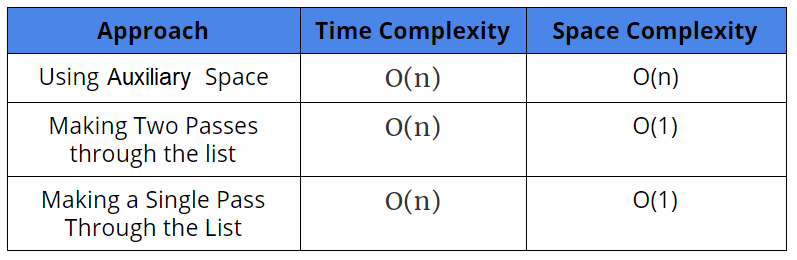
Time Complexity — O(n)
Space Complexity — O(n)
Critical Ideas to Thnik
- Why we are storing each node in an array?
- What will we return if the given value of n is 1?
- Why did we set the list[size-n-1]th node next pointer with list[size-n+1] ?
2. Making two passes through the list
You can conclude from the previous approach that we don’t actually need to store the nodes in the array as we only need the length — nth node.
So, we could say that the problem is simply reduced to: Remove the (L−n+1) th node from the beginning in the list, where L is the list length.
Solution Step
- Create a “dummy” node, which points to the list head.
- On the first pass, we find the list length L.
- Set a pointer to the dummy node and start to move it through the list until it comes to the
(L−n)thnode. - Relink the
nextpointer of the(L−n)thnode to the(L−n+2)thnode.
Pseudo Code
ListNode removeNthFromEnd(ListNode head, int n) {
    ListNode curr = head
    int end_index = 0
    while(curr) {
        end_index += 1
        curr = curr->next;
    }
    index_to_remove = end_index - n
    i = 0
    curr = head
    ListNode prev = nullptr
    while(i < index_to_remove) {
        prev = curr
        curr = curr.next
        i += 1
    }
    if(curr == head) {
        head = head.next
    }
    else if(prev) {
        prev.next = curr.next
    }
    delete curr
    return head
}
Complexity Analysis
Time complexity: O(L) where L is the length of the linked list.
Space complexity: O(1)
Critical Ideas to Think
- What information about the list does the first pass give us?
- What does the prev pointer represent here?
- Can you dry run the above pseudo code with the above examples?
3. Making a single pass through the list
We could optimize the above approach where we only need a one-time traversal of the linked list. We could create two pointers, namely slow and a fast pointer pointing to the nodes that are n nodes apart from each other.
The fast pointer advances the list by n+1 steps from the beginning, while the slow pointer starts from the beginning of the list separating them by n nodes. We maintain this constant gap by advancing both pointers together until the fast pointer arrives past the last node. The slow pointer will be pointing at the nth node counting from the last. We relink the next pointer of the node referenced by the second pointer to point to the node’s next to the next node.
Solution steps
- Create a fast and slow pointer pointing to n-1th and 0th node of the linked list
- Start iterating over the linked list while updating the slow and fast pointers to its next.
- When the loop terminates, then the fast pointer would be pointing to the last node and slow would be pointing to n-1th from the last node.
- Set the next of slow pointer to its next of next
- Now return the head.
Pseudo Code
ListNode* removeNthFromEnd(ListNode* head, int n) {
    ListNode fast = head
    ListNode dummy
    dummy->next = head
    ListNode slow = dummy
    int step_ahead = 0
    while(step_ahead < n-1){
        fast = fast.next
        step_ahead += 1
    }
    while(fast->next!=NULL){
        slow = slow.next
        fast = fast.next
    }
    //slow points to the node before target
    slow->next = slow->next->next
    return dummy->next
}
Complexity Analysis
Time complexity: O(L) where L is the length of the linked list.
Space complexity: O(1)
Critical Ideas to Think
- What did we initialize the fast and slow pointers with and why?
- How does the algorithm work if the given value of n is 1?
- Can you dry run this algorithm for the above example and point out the difference between the single pass and double pass algorithms?
Comparison of Different Solutions
Suggested problems to Solve
- K reverse linked list
- Reverse a Link List
- Delete a Doubly Linked List node at a given position
- Recursively delete a kth node from a linked list
If you have any more approaches or you find an error/bug in the above solutions, please comment down below.
Happy Coding! Enjoy Algorithms!
Written by AfterAcademy Tech
Share this article and spread the knowledge
Read Similar Articles
AfterAcademy Tech
Detect and Remove Loop In A Linked List
You are given the head of a linked list which probably contains a loop. If the list contains a loop, you need to find the last node of the list which points to one of its previous nodes to create a loop and make it point to NULL, thereby removing the loop.

AfterAcademy Tech
Remove Duplicates From a Sorted Linked List-Interview Problem
This is an interview problem asked by companies like Myntra, Visa, Oracle, Adobe, etc. The problem is to remove the duplicate nodes from the given Linked List so that only unique nodes(with unique data values) are present.

AfterAcademy Tech
Swap List Nodes in Pairs-Interview Problem
This is an interview problem asked in companies like Amazon and Microsoft. Given a Linked List you have to swap nodes of the list in pairs.

AfterAcademy Tech
Introduction to Node.js - How Node.js works?
In this article we will explore the core structures of the Node.js architecture. Node.js is a popular framework for building backend systems (network applications) which can scale very well. Node.js is a Javascript runtime based on Chrome V8 engine.