
Find the most frequent element in an array - Interview Problem

AfterAcademy Tech
•
05 Nov 2019

Level: Medium
Asked in: Facebook, Uber
Understanding the Problem
Problem Description: Given an array A[] of size n, find the most frequent element in the array, i.e. the element which occurs the most number of times. It is assured that at least one element is repeated.
For example:
Input: A[] = {3, 9, 1, 3, 6, 3, 8, 1, 6}
Output: 3
Input: A[] = {1, 9, 1, 3, 2, 3, 10}
Output: 1
Possible questions to ask the interviewer:-
- What should I return if two or more elements have the maximum frequency? (Ans: Return whichever element is the smallest)
- Can negative numbers exist in the array? (Ans: Yes, they can)
Brute force and Efficient Solutions
We will discuss three possible solutions for this problem:-
- Brute Force: Calculate frequency using nested loops
- Using Sorting: Calculate frequency linearly after sorting
- Using Hash Table : Use a Hash Table to find the frequency of elements
1. Brute Force Approach
For each element, scan the entire array to find its duplicates. Maintain two variables max_freq and ans to store the maximum frequency and the element with that frequency respectively.
Pseudo-Code
int findMostFrequentElement(int A[], int n)
{
    int max_freq = 0
    int ans = -1
    for (i = 0 to n-1)
    {
        int curr_freq = 1
        for (j = i+1 to n-1)
            if (A[j] == A[i])
                curr_freq = curr_freq + 1

        if (max_freq < curr_freq)
        {
            max_freq = curr_freq
            ans = A[i]
        }
       else if (max_freq == curr_freq)
            ans = min(ans, A[i])
    }
   return ans
}
Complexity Analysis
Time Complexity: O(n²) (Why?)
Space Complexity: O(1)
Critical ideas to think!
- According to this algorithm, the frequency is calculated again upon encountering the second occurrence of an element. How should we optimize this such that frequency is calculated only once for each unique element?
- How can we improve the time complexity further?
2. Using Sorting
If we sort the array, all the duplicate elements will get lined up next to each other. We can now linearly find the frequency of all elements in the array. This approach also ensures that frequency is calculated only once for each unique element.
Pseudo-Code
int findMostFrequentElement(int A[], int n)
{
    sort(A, n)
    int max_freq = 0
    int ans = -1
    int i = 0
    while (i < n)
    {
        int curr_freq = 1
        while (i+1 < n && A[i+1] == A[i])
        {
            curr_freq = curr_freq + 1
            i = i + 1
        }

        if (max_freq < curr_freq)
        {
            max_freq = curr_freq
            ans = A[i]
        }
        else if (max_freq == curr_freq)
            ans = min(ans, A[i])
        i = i + 1
    }
    return ans
}
Complexity Analysis
Time Complexity: Sorting the array + Linear Traversal of array
= O(nlogn) + O(n) = O(n)
Space Complexity: O(n), if we use merge sort and O(1) if we use heap sort
Critical ideas to think!
- If the frequency of the current element is equal to the maximum element, is it necessary to check if the current element is smaller than ans?
- How could you use the concept of time-space tradeoff to your benefit and find the frequency of all elements faster?
3. Using Hash Table
We can create a hash table and store elements and their frequency counts as key value pairs.
Solution Steps
1. Create a Hash Table to store frequency of each element in the given array. Consider elements in the array as key and their frequency as value
2. First scan the array one by one and check if value associated with any key (as that particular element) exist in the Hash Table or not
- If exist, increment the value of that key by 1
- If not, store the value as 1
3. During the iteration, we are also storing the most frequent element and its frequency in the parameter ans and max_freq respectively.
4. Update ans and max_freq if any value (frequency for that element) greater than the stored frequency is found.
5. And finally, return the most frequent element found i.e. return ans
Pseudo-Code
int findMostFrequentElement(int A[], int n)
{
    Create a HashTable H
    int max_freq = 1
    int ans = -1
    for (i = 1 to n-1)
    {
        if (A[i] in H)
        {
            H[A[i]] = H[A[i]] + 1
            if (max_freq < H[A[i]])
            {
                max_freq = H[A[i]]
                ans = A[i]
            }
            else if (max_freq == H[A[i]])
                ans = min(ans, A[i])
        }
        else
            H[A[i]] = 1
    }
    return ans
}
Complexity Analysis
Time Complexity: O(n) (Why?)
Space Complexity: O(n), for storing the Hash Table
Critical ideas to think!
- Is using a sophisticated data structure like BST useful here? Analyze the complexity in that case.
- What if all elements were unique, i.e, the maximum frequency is 1, will this code return output as expected? What changes will you make?
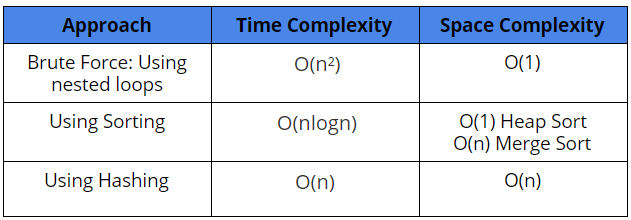
Comparison of different solutions
Suggested problems to solve
- Find the most frequent word in a sentence
- Sort characters by frequency
- Find the frequency of all words in a sentence
- Find the least frequent element in the array
- Find the top k frequent elements in the array
- Find the smallest subarray with all occurrences of the most frequent element
If you have any more approaches or you find an error/bug in the above solutions, please comment down below.
Happy Coding! Enjoy Algorithms!
Written by AfterAcademy Tech
Share this article and spread the knowledge
Read Similar Articles
AfterAcademy Tech
Find the next greater element for every element in an array - Interview Problem
Given an array A[] of size n, you need to find the next greater element for each element in the array. Return an array that consists of the next greater element of A[i] at index i.

AfterAcademy Tech
Find the majority element in an array - Interview Problem
You are given an array A[] consisting of n elements. You need to find and return the number which appears more than n/2 times.

AfterAcademy Tech
Find whether an array is a subset of another array - Interview Problem
Given two integer array A[] and B[] of size m and n(n <= m) respectively. We have to check whether B[] is a subset of A[] or not. An array B is a subset of another array A if each element of B is present in A. (There are no repeated elements in both the arrays)

AfterAcademy Tech
Find minimum and maximum value in an array - Interview Problem
Given an array A[] of size n, you need to find the maximum and minimum element present in the array.Your algorithm should make minimum number of comparisons.
