Reverse Bits

AfterAcademy Tech
•
15 Aug 2020
Asked In: Amazon
Difficulty: Easy
Understanding The Problem
Problem Description
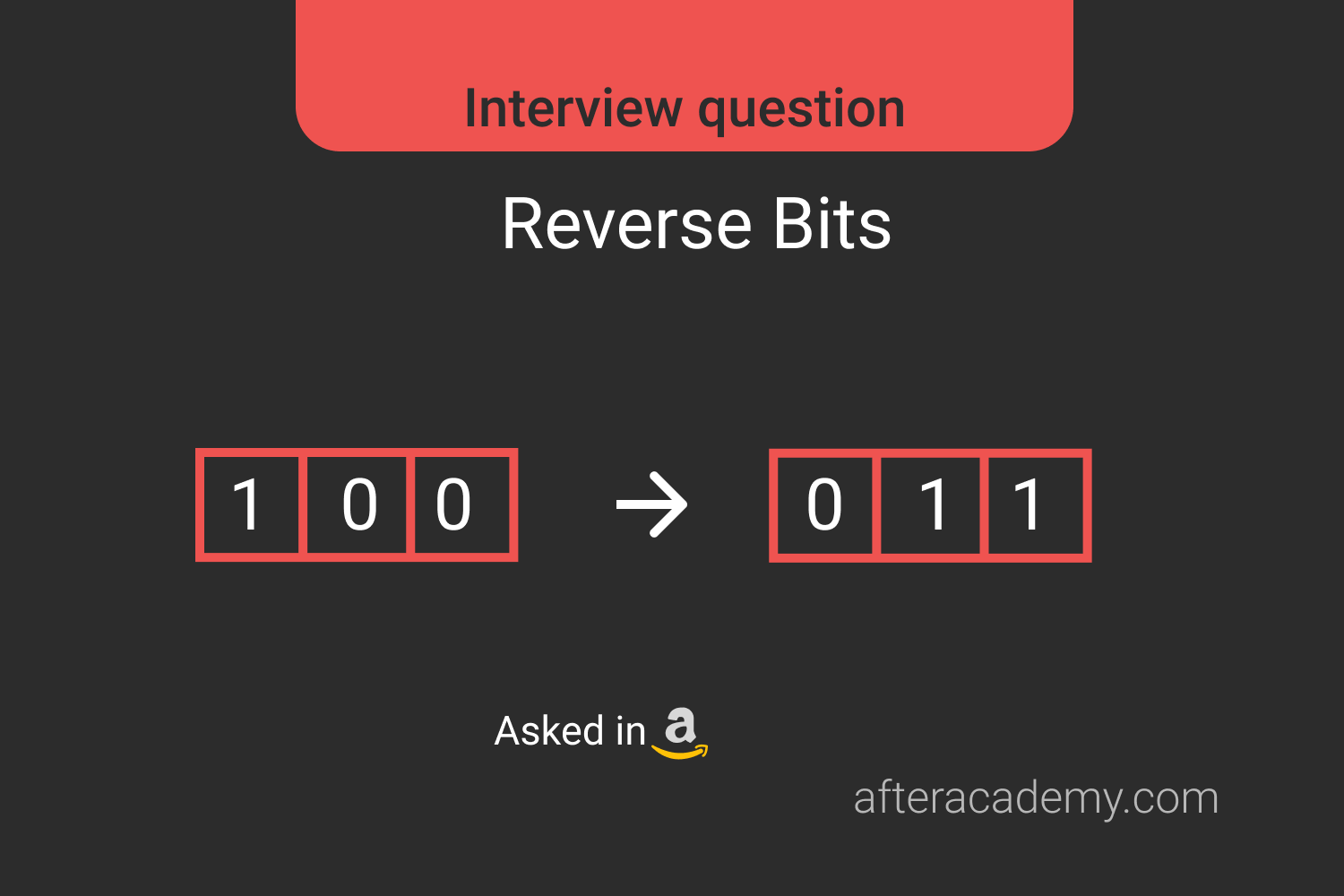
Given a non-negative integer num, write a program to return the number obtained after reversing the bits of num.
Problem Note:
- The actual binary representation of the number is being considered for reversing the bits, no leading 0’s are being considered.
Example 1
Input: 13
Output: 11
Explanation: Binary representation of 13 is 1101. After reversing the bits we get 1011 which is equal to 11.
Example 2
Input: 6
Output: 3
Explanation: Binary representation of 6 is 110.After reversing the bits we get 011 which is equal to 3.
Solution
Bit manipulation is an important concept and thus it explains how a number is stored in memory in the form of bits and how manipulating the bits will affect the value.
This problem requires the concept of bit manipulation, as the problem requires us to reverse the bits of a number.
Like in example 1, The binary of 13 is 1101. if we reverse 1011 then we will get 1101 which is the binary of 11.
So, all we have to do is to convert the decimal number(base 10) into binary(base 2) and then reverse the binary number and then convert it into decimal. But knowing the fact that the computers stores any numerical value in a binary form inside the memory, so we can use the concept and perform bit manipulation.
Look at the below example:
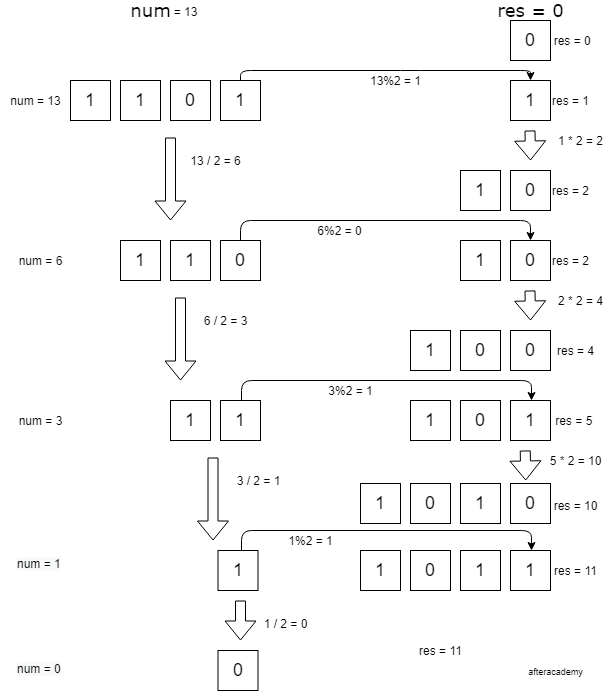
You will notice that each time we multiply res by 2, we basically shift the bits of res by one towards left. Similarly, each time we divide num by 2, we basically shift the bits of num by one towards the right. We can generalize the process of reversing the bits as shown above.
You may try the problem here.
Solution steps
To reverse the bits, we will perform the following operations
- Create a variable
resand initialize it with0 - If
num > 0
- Multiply
reswith 2 - If num is odd then add 1 to res.
- Divide
numby 2.
3. Repeat step 2, until num > 0 .
4. Return res.
Pseudo Code
int reverseBits(int num)
{
    int rev = 0
    // traversing bits of 'num' from the right
    while (num > 0)
    {
        // bitwise left shift
        // 'res' by 1
        res <<= 1     // multiply res by 2
        // if current bit is '1' or num is odd
        if (num & 1 == 1)
            res ^= 1  // Convert 0 to 1
        // bitwise right shift
        // 'num' by 1
        num >>= 1     // divide num by 2
    }
    // required number
    return res
}
Complexity Analysis
Time Complexity: O(n), where n is the number of bits in num.
Space Complexity: O(1)
Critical Ideas To Think
- How is the time complexity O(no. of bits)?
- Instead of multiplying
resby2,we didres<<=1, are these two same? - Instead of dividing
numby2we didnum>>=1, are these two same? - How did we check if
numis even or odd? - Besides doing the bit manipulation in another variable, can we create an integer array that would have stored the binary of
num, and then we would have reversed the array and we could have used the values of the array to create a decimal integer? Then will this procedure would have worked? If yes, then will the complexity would be the same as of the above approach?
Suggested Problems to Solve
- Invert actual bits of a number
- Set all odd bits of a number
- Check if the binary representation of a number is a palindrome
- Change all even bits to 0.
- Rotate bits of a number
If you have any more approaches or you find an error/bug in the above solutions, please comment down below.
Happy Coding!
Enjoy Algorithms!
Written by AfterAcademy Tech
Share this article and spread the knowledge
Read Similar Articles
AfterAcademy Tech
Reverse a Linked List
The problem is about reversing a Linked List. We are given the head node of the Linked List and we have to return the reversed Linked List's head. This is an interview problem asked in companies like Microsoft, Amazon and Adobe.

AfterAcademy Tech
Reverse An Array
Reverse a given array in-place. This question uses the concept of swapping.
AfterAcademy Tech
Reverse a Linked List from position M to N
This is an interview problem asked in companies like Amazon, Facebook and Microsoft. The problem is to reverse a linked list from position m to n and print the reversed linked list.

AfterAcademy Tech
Reverse a Stack Using Recursion
Given a stack of integers st, write a program to reverse the stack using recursion. This problem will clear the concept of recursion.