Matrix Chain Multiplication

AfterAcademy Tech
•
02 Jun 2020

Difficulty: Hard
Asked in: Amazon, Microsoft
Problem Description
Given a chain <M1, M2...Mn> of n two-dimensional matrices, write a program to fully parenthesize the product M1×M2×⋯×Mn in a way that minimizes the number of multiplications.
Problem Note:
- Input: Array of integers
Mrepresenting a chain of 2-D matrices such that the dimensions of thei-thmatrix isM[i-1] x M[i]. Find the most efficient way to multiply these matrices together. - Output: Return the minimum number of multiplications needed to multiply the chain.
- The problem is not actually to perform the multiplications,
but merely to decide in which order to perform the multiplications. - Assume that the matrix dimensions allow multiplication, in order
- Matrix multiplication is associative:
M1 (M2M3) = (M1M2) M3
Example 1
Input: M[] = [10, 20, 30, 40, 30]
Output: 30000
Explanation:
Dimensions of M1 = 10 x 20
Dimensions of M2 = 20 x 30
Dimensions of M3 = 30 x 40
Dimensions of M4 = 40 x 30
First, multiply M1 and M2,cost = 10*20*30 = 6000
Second, multilpy (Matrix obtained after multilying M1 and M2) and M3 =  10 * 30 * 40 = 12000
Third, multiply (Matrix obtained after multiplying M1, M2 and M3) and M4 =  10 * 40 * 30 = 12000
Total Cost = 6000 + 12000 + 12000 = 30000
Example 2
Input: M[] = [10, 20, 30]
Output: 6000
Explanation: There are only two matrices of dimensions 10x20 and 20x30.So there is only one way to multiply the matrices, cost of which is 10*20*30.
Understanding the problem
Given a chain of matrices, we want to multiply them. We cannot change the order of the matrices as that would change the result or make it incompatible, therefore we say matrix multiplication is not commutative.
In addition, regardless of how you parenthesize (e.g. whether the sequence as multiplied as A.(B.C) or (A.B).C ) the chain will give you the same answer, thus we say it is associative.
How we parenthesize the matrices also determines how many operations will be performed. For a multiplication chain of integers, parenthesizing them does not affect the number of operations performed, but for matrices the change is significant.
For example, given the matrices with the following dimensions:
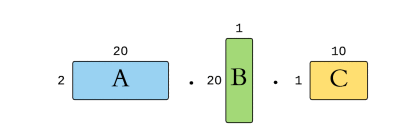
If we define a row of a matrix A as rA and the column as cA , then the total number of multiplications required to multiply A and B is rA.cA.cB.
A.(B.C) = 2*20*1 + 2*1*10 = 60multiplications(A.B).C = 20*1*10 + 2*20*10 = 600multiplications
Solution
We will be discussing two solutions for the problem
- Recursive Solution
- Dynamic Programming
You may try to solve the problem here.
1. Recursive Solution
To find the minimum number of operations needed to multiply the matrices, we need to derive some formula. Each matrix can only multiply with its adjacent matrix, a prefix can only start from A1 to some matrix Ak, and a suffix can only start from A(k+1) to An, split at some index k.
The resultant dimensions from multiplying 2 matrices are important to find the cost. In a sequence of matrices Ai . . . Aj If we split at a point k, the resultant dimensions of the prefix is ri * ck and the suffix is r(k+1) * cj. The cost of multiplying these 2 matrices are therefore ri * ck * cj .

Base case: When there is only 1 matrix. Then the prefix will be equal to the suffix, and there are no operations performed, so the cost would be 0.
Suppose we have a function B(i, j) that computes the minimum number of required operations for multiplying a chain of matrices from matrix i to matrix j. So in a range i to j, we select from j — i possibilities, from i until j — 1. Those possibilities in turn call B recursively until it hits the base case where i = j. We can thus derive the general solution img4 recursion formula
Solution Steps
1. Create a recursive function B, where B(i, j) returns the minimum number of operations for multiplying chain of matrices from i to j.
2. For each i and j, find k between i and j with the minimum cost of multiplication.
Pseudo Code
// recursive utility function
int B(int p[], int i, int j)
{
    if(i == j)
        return 0
    int min = INT_MAX
    int count
    for (int k = i to k < j) {
        count = B(p, i, k) +
                B(p, k + 1, j) +
                p[i - 1] * p[k] * p[j]
       if (count < min)
            min = count
    }
    return min
}
int matrixChainMultiplication(int[] p) {
    return B(p, 1, p.size()-1)
}
Complexity Analysis
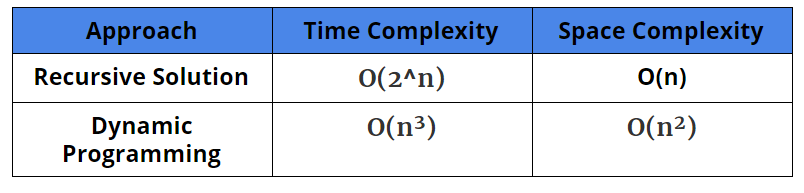
Time Complexity: O(2^n)
Space Complexity: O(n)
Critical Ideas to Think
- Why did we divide all the matrices into 3 parts?
- When
i == j(base case) then the function returns 0. Why? - Why are we adding
B(p, i, k),B(p, k + 1, j)andp[i — 1] * p[k] * p[j]for the minimum cost of multiplication? - What does B(i, j) represent here?
2. Dynamic Programming
If we draw the recursion tree for an array of length 4, we could find there are many overlapping subproblems.

The main problem has been broken down into small recurring subproblems (Overlapping Subproblems), which we can piece together to solve the main problem (Optimal Substructure).
1. Define the problem variable and decide the states: Looking at the function B, we will find that there are two parameters i and j on which the state of the problem depends.
2. Define Table Structure and Size: To store the solution of smaller sub-problems in the bottom-up approach, we need to define the table structure and table size.
- The table structure is defined by the number of problem variables. Since the number of problem variables, in this case, is 2, we can construct a two-dimensional array to store the solution of the sub-problems.
3. Table Initialization: We can initialize the table by using the base cases from the recursion.
- the base case is when
i = j, thenB(i, j) =0. icannot exceedj, so those areas will need to be greyed out.
4. Iterative Structure to fill the table: We can define the iterative structure to fill the table by using the recurrence relation of the recursive solution.
B(i, j) = B(i, k) + B(k + 1, j) + p[i - 1] * p[k] * p[j]
where k is between i and j
Let's look at the possibilities for an array of length 6.
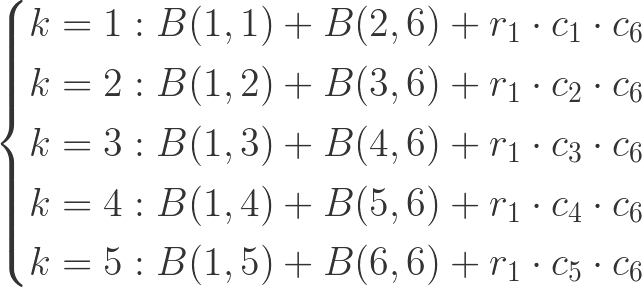
Solution Step
- Create a 2D Dp array.
- Fill DP array in a bottom-up manner as discussed above.
- return DP[1][n] as the least cost.
Pseudo Code
int matrixChainMultiplication(int[] p) {
    int c = p.size()
    int n = c - 1
    int[n][n] DP
    for (int w = n to w > 0) {
        int q = n - w
        for (int j = n to j > q) {
            int i = j - q - 1
            DP[i][j] = INT_MAX
            for (int k = i to k < j) {
                DP[i][j] = min(DP[i][j], DP[i][k] + DP[k + 1][j]
                    + p[i] * p[k + 1] * p[j + 1])
            }
        }
    }
    return DP[1][n]
}
Complexity Analysis
Time Complexity: O(n³)
Space Complexity: O(n²)
Critical Ideas to Think
- Why did we use a 2D-Dp array?
- How the result is stored in
DP[1][n]? - Do you think that there would not be any value in the lower triangle of DP because
icannot exceed thanj? - Can you dry run the algorithm for an example
pand check how does the DP array is storing the results?
Comparison of Different Solutions
Suggested Problems to Solve
- Program for scalar multiplication of a matrix
- Implement Strassen’s Matrix Multiplication Algorithm
- Maximum Length Chain of Pairs
- Tiling Problem
If you have any more approaches or you find an error/bug in the above solutions, please comment down below.
Happy Coding! Enjoy Algorithms!
Written by AfterAcademy Tech
Share this article and spread the knowledge
Read Similar Articles
AfterAcademy Tech
Rotate Matrix
Given a square matrix, turn it by 90 degrees in the clockwise direction.

AfterAcademy Tech
Spiral Order Traversal of a Matrix
Given a matrix or a 2-d array, you have to traverse the matrix in a spiral order. This is an interview question asked by companies like Microsoft and Amazon.

AfterAcademy Tech
Smallest Multiple With 0s and 1s
You are given an integer n, write a program to find the smallest multiple of n which consists of 0 and 1. The resultant number could be quite large so return it in the form of a string. This problem is a good example of graph-based problems.

AfterAcademy Tech
Search in a 2-D Matrix
You are given a matrix arr of m x n size. Write a program to searches for a value k in arr. This arr has the following properties: - Integers in each row are sorted from left to right. - The first value of each row is greater than the last value of previous row. This is a basic optimization problem that will clear the concept of searching.