Interleaving Strings

AfterAcademy Tech
•
18 Jul 2020
Difficulty: Hard
Asked in: Google, Microsoft, Yahoo
Understanding The Problem
Problem Description
Given three strings S1, S2 and S3, write a program that checks whether S3 is an interleaving of S1 and S2.
Problem Note:
S3is said to be interleavingS1andS2if it contains all characters ofS1andS2and the order of all characters in individual strings is preserved.
Example 1
Input: S1 = "xxyzz", S2 = "wyyzx" and S3 = "xxwyyzyzxz"
Output: true
Explanation:"xx" (from S1) + "wyyz" (from S2) + "yz" (from S1) + "x" (from S2) + "z" (from S1)
Example 2
Input: S1 = "xxyzz", S2 = "wyyzx", S3 = "xxwyyyxzzz"
Output: false
Explanation: It is not possible to get S3 by interleaving S1 and S2.
Solutions
- Brute Force
- Dynamic Programming
You may try this problem here.
1. Brute Force Approach
If you will look at the above examples, you will conclude that there are two possibilities that need to be taken care of :-
- If the first character of
S3matches the first character ofS1, we move to the next character ahead inS1andS3and recursively call the function. - If the first character of
S3matches the first character ofS2, we move to the next character ahead inS2andS3and recursively call the function.
Solution Step
- Check if
S1,S2,andS3are empty, then return True. This will be the base case for our recursive function as emptyS3is interleaving ofS1andS2. - Check if
S3is empty and either ofS1andS2is not empty, then return False, which will meanlen(S3)is smaller thanlen(S1) + len(S2)(How?) - Now if those are not the case, then move ahead with the two possibilities discussed above.
- If
S3[0] == S1[0], then check forS1[1…], S2, S3[1...] - If
S3[0] == S2[0]then check forS1, S2[1…], S3[1…] - If any of the above mentioned two possibilities is true, then return true, otherwise false
Pseudo Code
bool isInterleaved( char[] S1, char S2, char S3) {
    // Base Case: If all strings are empty
    if ( not (len(S1) != 0 or len(S2) != 0 or len(S3) != 0) )
        return true
    if (len(S3) == 0)
        return false
    return ((S3[0] == S1[0]) and isInterleaved( S1 + 1, S2, S3 + 1))
      or ((S3[0] == S2[0]) and isInterleaved( S1, S2 + 1, S3 + 1))
}
Complexity Analysis
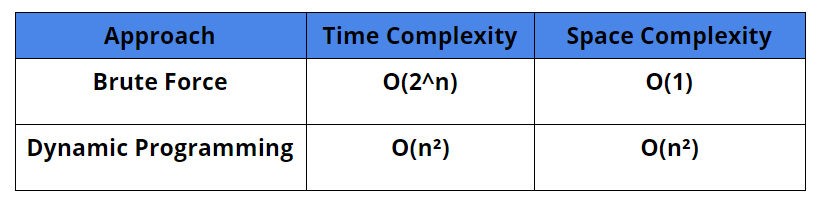
Time Complexity: O(2^n)
For every character of S3, there can be 2 options so the time complexity is O(2^n).
Space Complexity: O(1), not considering recursion stack space.
Critical Ideas To Think
- Can you explain, how did the base help in solving the problem?
- What did we do, when the first character of
S3matches with both the first character ofS1and the first character ofS2?
2. Dynamic Programming
The above recursive solution certainly has many overlapping sub-problems. For example, if we consider S1 = “AAA”, S2 = “AAA” and S3 = “AAAAAA” and draw recursion tree, there will be many overlapping subproblems. Therefore, the solution to this problem could be optimized using Dynamic Programming.
The idea is to build a two-dimensional DP table, according to the drawn path displayed below. Because it’s interleaving, so certain order still needs to be maintained, so that’s why for a valid path, it can only go right or down. That’s why DP[i][j] is depending on DP[i - 1][j] and DP[i][j - 1].
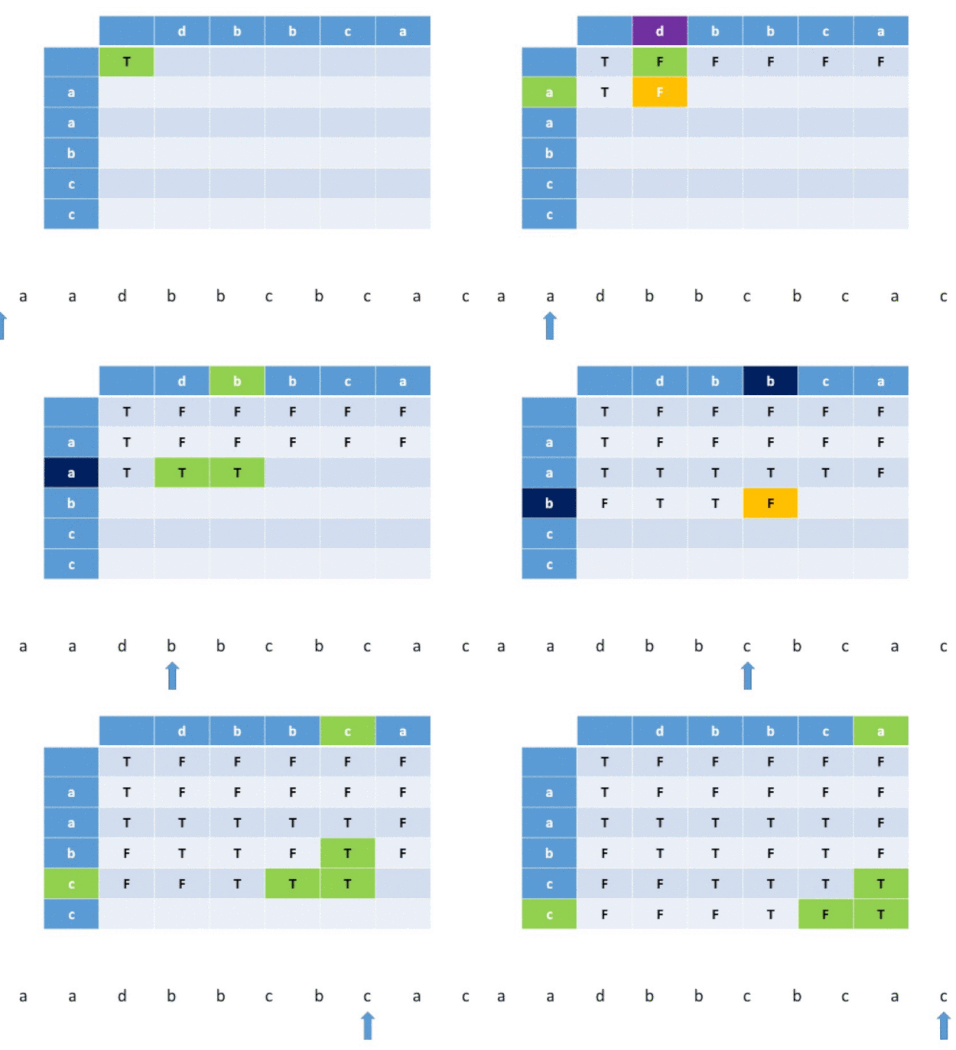
After discovering the transition rule to get DP[i][j], we just need to record true or false in the DP table. DP[i][j] means if s3.substr(0, i + j) can be formed by s1.substr(0, i) interleaving s2.substr(0, j) .
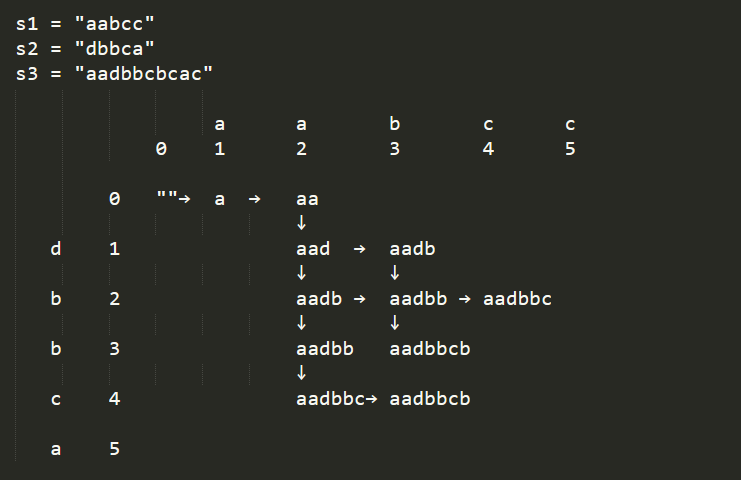
If you will look over the above example, you will understand how will DP table will help to build the solution.
To implement this method, we’ll make use of a 2D boolean DP array. In this array DP[i][j] implies if it is possible to obtain a substring of length (i+j+2) which is a prefix of S3 by some interleaving of prefixes of strings S1 and S2 having lengths (i+1) and (j+1) respectively.
In short, DP table represents if S3 is interleaving at (i+j)th index when S1 is at ith index, and S2 is at jth index. 0th index means an empty string.
So, if both S1 and S2 is currently empty, S3 is empty too, and it is considered interleaving. If only, S1 is empty, then if the previous S2 position is interleaving and the current S2 position character is equal to S3 current position character, it is considered interleaving. A similar idea applies when S2 is empty. when both S1 and S2 are not empty, then whenever we arrive i, j from i-1, j, and if i-1,j is already interleaving and i and current S3 position are equal, then they are interleaving. If we arrive i,j from i, j-1, and if i, j-1 is already interleaving and j and current S3 position equal then also it is interleaving.
Visualization for a example
Solution Steps
- Create a 2D boolean DP array of size
m+1, n+1. Wheremandnare the lengths ofS1andS2 - Now fill the DP table by comparing the characters of S1, S2 with S3 accordingly.
- Return
DP[m][n]
Pseudo Code
bool isInterleave(char[] S1, char[] S2, char[] S3) {
    if(S3.length() != S1.length() + S2.length())
        return false

    bool DP[S1.length()+1][S2.length()+1]

    for(int i=0 to i < s1.length()+1)
        for(int j=0 to j < s2.length()+1){
            if(i==0 and j==0)
                DP[i][j] = true
            else if(i == 0)
                DP[i][j] = ( DP[i][j-1] and S2[j-1] == S3[i+j-1])
            else if(j == 0)
                DP[i][j] = ( DP[i-1][j] and S1[i-1] == S3[i+j-1])
            else
                DP[i][j] = (DP[i-1][j] and S1[i-1] == S3[i+j-1] ) or
                           (DP[i][j-1] and S2[j-1] == S3[i+j-1] )
        }

    return DP[S1.length()][S2.length()]
}
Complexity Analysis
Time complexity: O(m⋅n)
Space complexity: O(m⋅n).
Where m and n are the lengths of S1 and S2 respectively.
Critical Ideas To Think
- Can you prove that the transaction formula for this problem is
dp[i][j] = (dp[i-1][j] & s3[i+j-1] == s1[i-1]) || (dp[i][j-1] & s2[j-1] == s3[i+j-1])? - Can you think of a BFS approach for this problem?
- The two possibilities discussed in the recursion approach have been taken care of in this approach. How?
- An approach is to just merge the two strings. A pointer into each string. If the present character in the interleaved string c equals one of the strings a or b, increase the pointer to that string and to c, if not then return false. Do this for every character in c. Complexity will be O(m+n). Do you think, this approach will work? If not then, can you find a failing test case for such an approach?
Comparison Of Solutions
Suggested Problems To Solve
- Longest Palindromic Substring
- Longest Valid Parentheses
- Edit Distance
- Distinct Subsequences
If you have any more approaches or you find an error/bug in the above solutions, please comment down below.
Happy Coding!
Enjoy Algorithms!
Written by AfterAcademy Tech
Share this article and spread the knowledge
Read Similar Articles
AfterAcademy Tech
Check if two strings are anagrams of each other - Interview Problem
Given two strings S1 and S2 of size m and n respectively, you need to check whether the two strings are an anagram of each other or not. S1 is an anagram of S2 if the characters of S1 can be rearranged to form S2.
AfterAcademy Tech
First Unique Character In A String
Given a string S, write a program to find the first non-repeating character in it and return its index. The problem needs to be solved in O(n) and needs the knowledge of a hash map to solve.
AfterAcademy Tech
Valid Anagram
Write a program to check whether the two strings are an anagram of each other or not. Like, "s" is an anagram of "t" if the characters of "s" can be rearranged to form "t". This simple problem will let you understand the concepts of string manipulation.
AfterAcademy Tech
Edit Distance
Write an algorithm to find the minimum number of operations required to convert string S1 into S2.