Difference between a Domain and a Workgroup

AfterAcademy Tech
•
03 Mar 2020
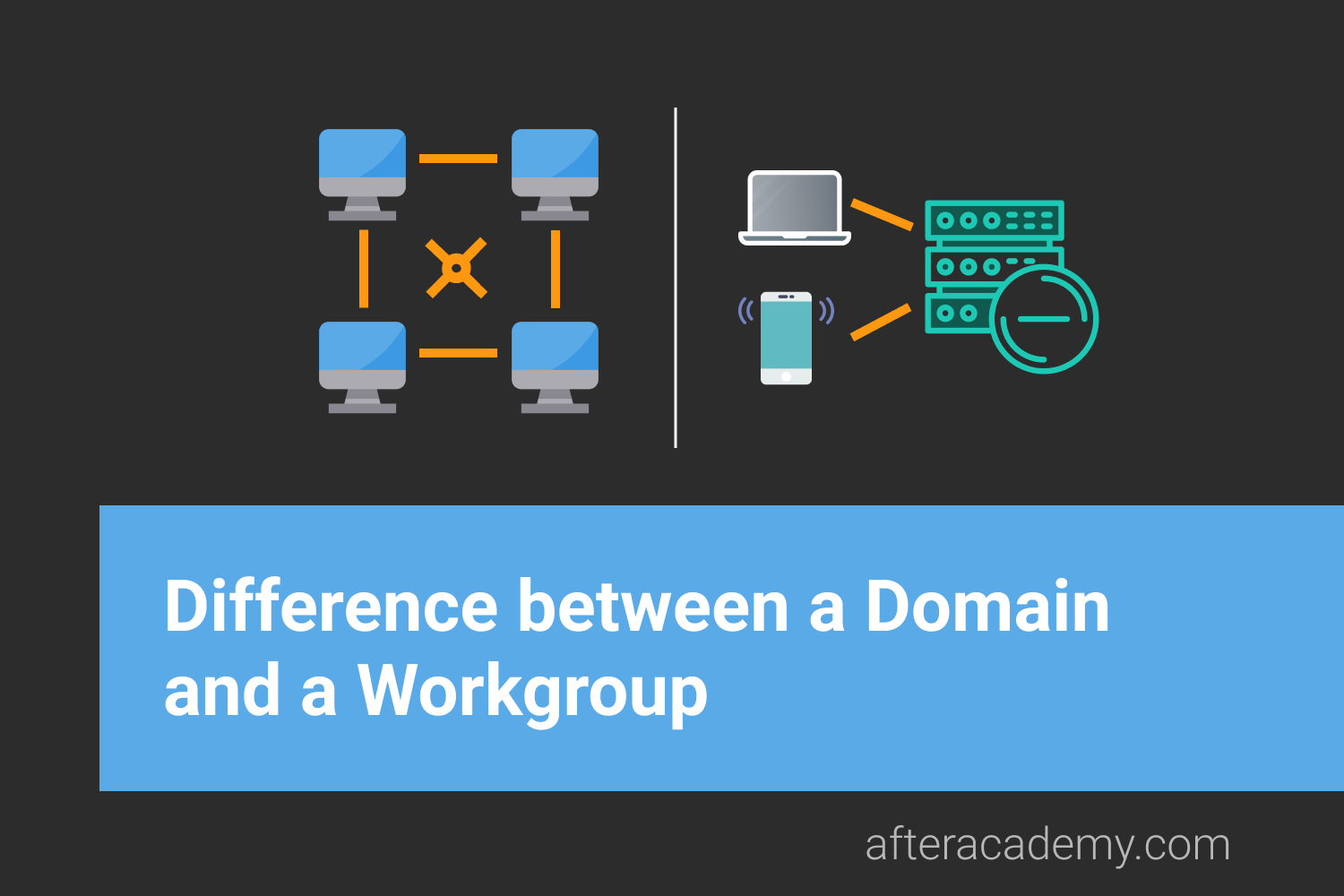
In the present day scenario, the computer network is spreading vastly. In various situations, we need to sub-divide our network into multiple small networks to easily administer and manage the network and its resources. These goals can be easily achieved by creating a network domain or workgroup in computer networks.
Both domain and workgroup can be used to group the computers to sub-divide the network. But, they have different functionalities and applications. So in this blog, we’ll learn about domains and workgroups in a computer network. We will also see the applications and differences between these two in detail.
Now, let us first learn about these two terms one by one.
Domain
A domain can be seen as a logical grouping of computers or devices on the same or different kinds of networks. Each computer on a domain is administered by a centralized server that manages each computer within a domain. These network domains are uniquely identified using unique domain names that are assigned by a domain controller. A domain controller acts as a server within a domain for the domain hosts and provides the authentication services, domain names, and various functionalities to them. One of the major functionality of using a domain is secure access in which no other computer outside the domain can access the domain computers. The domain controller can also be used as a centralized database for storage which can be shared by all the devices over a particular domain.
A host computer can be added to a domain via LAN, WAN, or VPN. A computer connected in a domain can access any computer on that domain to access their files and resources. On the Internet, network domains can be identified using the IP address. If two devices share some common part of the IP address, they are said to be in a common network domain. For example, if two devices have IP addresses - 192.168.10.2 and 192.168.10.3, then they are said to be in the same network domain. A domain can have multiple sub-domains. A router can be used to connect different networks and sub-domains.
A domain has centralized control over the devices in the domain. It also has some features like reliability, scalability, etc. There is a need for some specialized software for creating and managing domains. Most of the O.S. provides some inbuilt software for these purposes. Domains are mainly used in a ‘Client-Server’ model and are beneficial when the number of computers is very large. A network domain can be mainly used where we want to sub-divide the network, and also want to join multiple networks having different architecture.
For example, in an organization, if we want that all the computers can share the resources of one another and have their full access. Also, we need some centralized control over the devices, then we can achieve these goals by creating a network domain and adding all the intended devices to it.
Workgroup
A workgroup is a collection of autonomous computers that are connected over a network and can share common files, resources, and responsibilities with one another. It is approximately the same as a workgroup, i.e., it can be used to sub-divide or categorize a network. But the main difference is that it has no centralized control over the devices in the workgroup. It can be implemented to sub-divide a large network into workgroups for better management.
A workgroup name is not provided by any server. Also, there is no dependency on any hardware components for assigning workgroup names. In general, we provide some workgroup names to some devices, and they start working as a workgroup.
A workgroup mainly implements a peer-to-peer networking model, where each computer is autonomous having its own user account and permissions, memory, and are equally important. Also, these computers are not so secure. They have local security, i.e., each device maintains its own security. It may also happen that one computer in the workgroup may not have access permissions to all the computers in that particular workgroup. Every computer has to maintain its own user accounts and access permissions.
A workgroup can have the computers of the same network only. These computers can be connected using a hub or a switch. It is very easy to install and configure and is beneficial for fewer computers only. Most of the O.S. provides some inbuilt software for creating and managing the workgroups. A workgroup is beneficial to be used in small local area networks like schools, colleges, buildings, etc.
Following are the differences between domain and workgroup:
- Installation and Configuration: A domain is complex than a workgroup to install and configure. On the other hand, a workgroup is easy to install and configure, but it is very hard to maintain.
- Networking Model: Domain is based on a client-server model, where multiple clients rely on a single server for various services. On the other hand, a workgroup is based on a peer-to-peer model where each computer is equally important.
- Administration and Management: A domain has centralized control over the device. On the other hand, the administration and management of a workgroup are non-centralized in nature.
- Database: The computers in a domain have a centralized database. On the other hand, each computer in a workgroup mainly has its own local database.
- Autonomous: The devices connected in a domain are not autonomous, they are governed by centralized servers. On the other hand, the devices connected in a workgroup are mainly autonomous in nature.
- Naming: In the case of a domain, the domain names are provided by the domain controllers on the basis of IP address. On the other hand, there are no dependencies on any hardware components and server for assigning the workgroup names.
- User account and groups: The user accounts and groups are manages and maintained on the domain level. On the other hand, in a workgroup, it is managed and maintained by every computer of the workgroup individually.
- Location: A domain can be formed using the devices of one or more different networks. On the other hand, the devices of the same network can only be added to a workgroup.
- The number of computers: A domain can work better when there is a large number of devices connected to it. On the other hand, a workstation can work better with fewer computers.
- Scalability: A domain has a centralized control and is easy to scale. On the other hand, a workgroup is very hard to scale due to no centralized control. The complexity enhances when we increase the number of workgroup computers.
- Security: A domain has very advanced security due to centralized control. On the other hand, a workgroup is very less secure due to no centralized access control.
- Data Recovery: Data can be recovered in a domain from the centralized storage. On the other hand, data recovery is not possible in a workgroup due to the local storage of each computer.
- Type of data: A domain is mainly used to transfer and share sensitive and important data due to security. On the other hand, a workgroup is used to share less secure and personal data only due to less security.
- Application: A domain is mainly preferred for large public and business networks. On the other hand, a workgroup is mainly preferred for small local area networks like schools, colleges, buildings, etc.
This is all about the domain and workstation in computer networks and the differences between them. Hope you learned something new today. That's it for this blog.
Do share this blog with your friends to spread the knowledge. Visit our YouTube channel for more content. You can read more blogs from here.
Keep Learning 🙂
Team AfterAcademy!
Written by AfterAcademy Tech
Share this article and spread the knowledge
Read Similar Articles
AfterAcademy Tech
What is the difference between SQL and MySQL?
In this blog, we will learn the difference between SQL and MySQL. People use these terms intechangeably. But both are having different meanings.

AfterAcademy Tech
What is the difference between DBMS and RDBMS?
In this blog, we will learn what is RDBMS and how it is different from DBMS. People often use these words intechangeably. But there is a difference between these two terms. So, let's learn how.
AfterAcademy Tech
What is the difference between HAVING and WHERE clause?
In this blog, we will learn how WHERE and HAVING clause are used and then see what are the main differences between the WHERE clause and HAVING clause.

AfterAcademy Tech
Difference between Mutex and Semaphore in Operating System
In this blog, we will learn about the difference between Mutex and Semaphore in the Operating System. We will first learn about Mutex and Semaphore and after that, we will find the difference between them.